
Corporate Compliance Essentials – Safeguarding High-Risk Ventures


Nearly half of crypto startups surveyed in British regulatory markets flagged compliance as their most pressing operational challenge. For leaders navigating the unpredictable worlds of cryptocurrency and online gambling, understanding corporate compliance is not just box-ticking but a lifeline for business survival. This guide clarifies how strong compliance strategies protect companies from costly risks and empower you to confidently manage legal obligations across British, European, and global jurisdictions.
Table of Contents
Key Takeaways
Point | Details |
Corporate Compliance is Essential | In high-risk sectors, compliance is crucial for mitigating legal vulnerabilities and ensuring sustainable operations. |
Holistic Compliance Frameworks | Effective compliance requires integrating regulatory, legal, operational, and ethical considerations into cohesive governance structures. |
Continuous Adaptation Required | Organisations must develop dynamic systems for adapting to evolving regulations and emerging technological challenges. |
Utilise Technology for Compliance | Implement advanced compliance management systems to automate processes and enhance transparency and monitoring capabilities. |
Defining Corporate Compliance in High-Risk Sectors
Corporate compliance represents a systematic approach organisations implement to ensure adherence to legal standards, regulatory requirements, and ethical practices within complex operational environments. In high-risk sectors such as cryptocurrency, online gambling, and financial technologies, compliance becomes not merely a recommendation but a critical survival mechanism for sustainable business operations.
At its core, corporate compliance involves managing organisational risk exposure through comprehensive governance frameworks that integrate legal, ethical, and operational standards. These frameworks encompass multiple dimensions, including regulatory alignment, internal controls, risk assessment, and accountability mechanisms designed to protect stakeholder interests and mitigate potential legal vulnerabilities.
The complexity of corporate compliance in high-risk sectors demands a multifaceted approach. Companies must develop robust enterprise risk management strategies that transcend traditional regulatory checklists. This involves creating dynamic systems capable of adapting to rapidly evolving regulatory landscapes, technological innovations, and emerging global compliance challenges. Effective compliance programmes require continuous monitoring, proactive risk identification, and agile response mechanisms that can quickly address potential regulatory breaches.
Pro tip: Implement a dedicated compliance management software that provides real-time regulatory updates and automated compliance tracking to stay ahead of evolving legal requirements in high-risk sectors.
Main Types and Key Compliance Requirements
Corporate compliance encompasses a multifaceted approach to managing organisational risks and regulatory obligations across different critical domains. Understanding the primary types of compliance is fundamental for businesses operating in complex and highly regulated environments, particularly within high-risk sectors such as financial technologies, online gambling, and cryptocurrency services.
The primary types of corporate compliance include comprehensive regulatory and legal frameworks that address multiple strategic dimensions. These typically encompass four essential categories: regulatory compliance, which ensures adherence to industry-specific governmental regulations; legal compliance, focusing on overall legal requirements and statutory obligations; operational compliance, which governs internal processes and procedures; and ethical compliance, establishing standards for organisational conduct and professional integrity.
Key compliance requirements demand a holistic approach that integrates multiple critical components. Effective compliance programmes must incorporate clear policy documentation, robust employee training initiatives, leadership commitment, continuous risk assessment methodologies, proactive monitoring systems, transparent reporting mechanisms, and consistent enforcement of established standards. For high-risk sectors, this translates into developing dynamic frameworks capable of adapting to rapidly evolving regulatory landscapes while maintaining rigorous internal controls and demonstrating unwavering commitment to legal and ethical standards.
In practice, compliance requirements vary significantly across different industries, necessitating tailored approaches that address sector-specific challenges. Financial services might prioritise anti-money laundering protocols, while technology companies could emphasise data privacy and cybersecurity frameworks. The overarching goal remains consistent: creating comprehensive systems that mitigate potential risks, protect stakeholder interests, and ensure organisational resilience in complex regulatory environments.
The table below outlines how compliance priorities differ across high-risk sectors:
Sector | Core Compliance Focus | Typical Regulatory Body |
Cryptocurrency | Anti-money laundering, market integrity | Financial Conduct Authority (UK), MiCA (EU) |
Online Gambling | Know Your Customer, responsible gaming | UK Gambling Commission, MGA (Malta) |
Financial Technology | Data privacy, operational transparency | Financial Services Authority (various countries) |
Pro tip: Develop a centralised compliance dashboard that provides real-time tracking of regulatory changes, internal policy adherence, and potential risk indicators across your organisation.
Legal Frameworks for Crypto and Gambling Industries
Legal frameworks in crypto and gambling industries represent complex regulatory ecosystems that continuously evolve to address emerging technological challenges and protect stakeholder interests. These dynamic regulatory environments demand sophisticated, nuanced approaches that balance innovation with robust consumer protection mechanisms, particularly in high-risk digital sectors characterised by rapid technological transformation.
The European Union has pioneered progressive regulatory strategies, establishing comprehensive crypto-asset regulations through mechanisms like the Markets in Crypto-Assets Regulation (MiCA). This groundbreaking framework addresses critical challenges including consumer protection, market integrity, and risk mitigation by implementing stringent requirements for crypto-asset issuers, service providers, and custodians. The regulation specifically targets potential risks associated with price volatility, money laundering, and market manipulation, providing a structured approach to managing digital asset ecosystems.
Global cryptocurrency gambling regulations demonstrate significant variation across international jurisdictions, reflecting divergent approaches to digital asset governance. Jurisdictions like the United Kingdom and Malta have developed sophisticated regulatory sandboxes and clear operational guidelines, while other regions maintain more restrictive or cautious regulatory stances. These frameworks typically incorporate mandatory Anti-Money Laundering (AML) and Know Your Customer (KYC) protocols, designed to ensure transparency, prevent financial crimes, and protect consumer interests in increasingly complex digital gambling environments.
Effective legal frameworks in crypto and gambling industries must remain adaptable, anticipating technological shifts and potential regulatory challenges. This requires continuous monitoring of global regulatory trends, proactive compliance strategies, and a commitment to maintaining highest standards of operational integrity across digital platforms.
Pro tip: Engage specialised legal counsel with demonstrable expertise in international digital asset regulations to develop comprehensive, jurisdiction-specific compliance strategies.
Implementing Effective Compliance Processes and Controls
Compliance processes represent the critical infrastructure that enables organisations to navigate complex regulatory landscapes while maintaining operational integrity and risk management. These systematic approaches transform abstract regulatory requirements into tangible, actionable frameworks that protect businesses from potential legal and financial vulnerabilities.
Comprehensive compliance implementation demands a multifaceted strategy that integrates clear governance structures, dedicated leadership, and risk-based methodologies. Successful programmes establish robust internal controls that extend beyond mere regulatory checklist completion, embedding compliance considerations directly into organisational decision-making processes. This approach requires developing systematic mechanisms for continuous monitoring, regular assessments, and proactive identification of potential regulatory risks across all operational domains.

Technology plays an increasingly pivotal role in enhancing compliance effectiveness. Advanced compliance management systems leverage data-driven approaches, automating complex workflow processes and enabling real-time tracking of regulatory obligations. These technological solutions facilitate dynamic updating of compliance requirements, streamline auditing processes, and provide organisations with sophisticated tools for maintaining transparency and accountability across intricate regulatory environments.
Effective compliance implementation is not merely a technical exercise but a cultural transformation. It requires creating an organisational ecosystem where regulatory adherence is understood as a collective responsibility, with clear communication channels, ongoing training programmes, and a proactive approach to risk management that permeates every level of the organisational hierarchy.
The following table summarises major compliance process enhancements enabled by technology:
Technological Tool | Compliance Benefit | Business Impact |
Automated monitoring systems | Real-time breach detection | Faster response to incidents |
Centralised policy dashboards | Policy updates tracked instantly | Reduces manual oversight burden |
Risk assessment software | Proactive vulnerability alerts | Fewer regulatory penalties |
Pro tip: Conduct quarterly comprehensive compliance audits that integrate both technological monitoring tools and human expertise to identify and address potential regulatory vulnerabilities.
Liabilities, Risks, and Common Pitfalls
Corporate liability represents a complex landscape of potential legal, financial, and reputational risks that organisations must strategically navigate in high-risk sectors. Understanding these risks is crucial for developing robust compliance frameworks that protect businesses from potentially devastating consequences of regulatory breaches and operational failures.
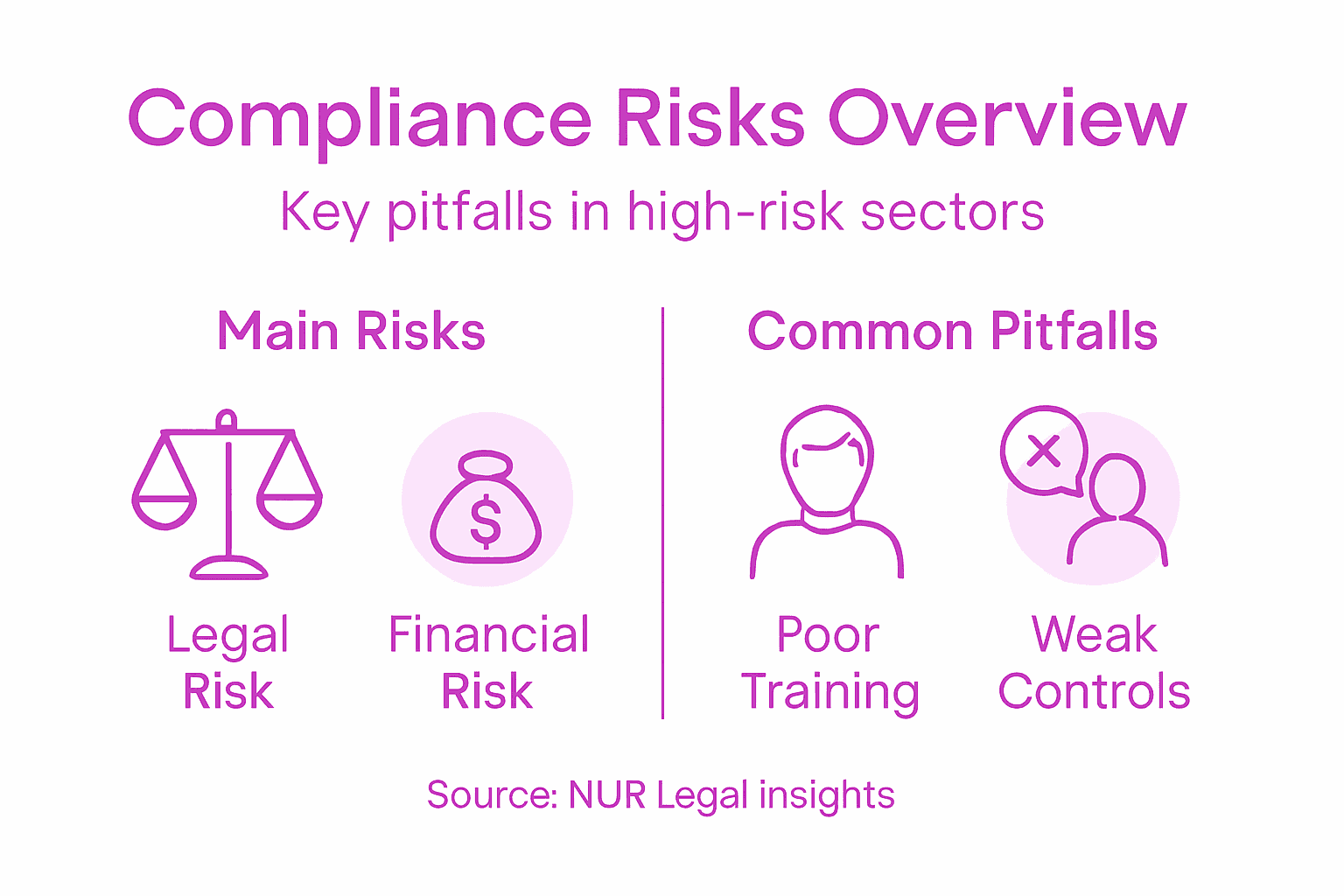
Compliance risk management requires a nuanced approach that balances the marginal costs of compliance investments against potential liability exposures. This strategic calculus involves assessing agency conflicts, cultural legitimacy challenges, and the inherent discrepancies between organisational risk assessments and broader public policy expectations. Businesses must develop sophisticated risk mitigation strategies that go beyond simple regulatory adherence, focusing instead on creating comprehensive protective mechanisms that anticipate and neutralise potential vulnerabilities.
In high-risk sectors such as cryptocurrency and online gambling, common compliance pitfalls include inadequate due diligence, insufficient anti-money laundering protocols, incomplete know-your-customer processes, and failure to maintain transparent financial reporting. These vulnerabilities can expose organisations to significant legal and financial risks, including substantial monetary penalties, loss of operational licences, and irreparable reputational damage. Successful risk management demands a proactive approach that integrates continuous monitoring, rapid response capabilities, and a culture of transparency and ethical conduct.
The most effective compliance strategies recognise that risk management is not a static checklist but a dynamic, evolving process requiring constant adaptation to changing regulatory landscapes, technological innovations, and emerging global challenges. This demands ongoing investment in robust compliance infrastructure, sophisticated technological solutions, and a organisational culture that prioritises regulatory integrity.
Pro tip: Develop a comprehensive risk assessment matrix that quantifies potential compliance vulnerabilities and assigns specific mitigation strategies for each identified risk.
Secure Your High-Risk Venture with Expert Legal Compliance Support
Navigating the complexities of corporate compliance in high-risk sectors such as cryptocurrency, online gambling, and fintech demands specialised expertise. Businesses face challenges like adapting to evolving legal frameworks, managing regulatory risks, and implementing robust internal controls. At NUR Legal, we understand these unique pain points and offer tailored solutions to help you build resilient, legally compliant operations. Whether you require assistance with obtaining gaming or crypto licenses or need precise legal opinions and contract reviews, our team is dedicated to safeguarding your venture.
Take control of your compliance journey today. Visit NUR Legal to explore our trusted licensing services, including gaming licensing in Curaçao or Anjouan and crypto license solutions in Georgia and Seychelles. Act now to benefit from our efficient, transparent, and affordable legal consultancy that positions your business for success in challenging regulatory environments.
Frequently Asked Questions
What is corporate compliance in high-risk sectors?
Corporate compliance in high-risk sectors refers to a systematic approach that organisations implement to ensure adherence to legal standards, regulatory requirements, and ethical practices to manage risk exposure effectively.
Why is compliance critical for businesses in high-risk industries?
Compliance is critical for businesses in high-risk industries because it serves as a crucial mechanism to protect against legal vulnerabilities, operational risks, and reputational damage. It ensures sustainable business operations within a complex regulatory environment.
What are the key components of an effective compliance programme?
An effective compliance programme should include clear policy documentation, robust employee training, leadership commitment, continuous risk assessment, proactive monitoring systems, transparent reporting mechanisms, and consistent enforcement of established standards.
How can technology enhance compliance processes?
Technology can enhance compliance processes by automating complex workflows, providing real-time tracking of regulatory obligations, facilitating dynamic updates of compliance requirements, and enabling organisations to maintain transparency and accountability across intricate regulatory environments.
Recommended


Comments