
Why Global Compliance Matters for High-Risk Sectors


Global expansion is never simple when nearly 60 percent of fintech startups cite regulatory complexity as their top challenge. For british compliance officers in financial technology and cryptocurrency, understanding and managing evolving international requirements is critical. Whether entering the European Union, United States, or Asian markets, staying ahead of legal risks can mean the difference between market success and costly setbacks. This guide explains how building strong compliance frameworks protects your business and reputation worldwide.
Table of Contents
Key Takeaways
Point | Details |
Global Compliance Importance | Organisations must develop robust strategies to meet diverse regulatory requirements across jurisdictions to mitigate legal risks. |
Types of Compliance | Understanding financial, sectoral, and cross-border compliance is essential for organisations operating in high-risk sectors to navigate regulatory challenges effectively. |
Risks of Non-Compliance | Non-compliance can lead to severe financial penalties, reputational damage, and operational disruptions that threaten the sustainability of businesses. |
Culture of Compliance | Establishing a strong compliance culture requires leadership commitment, transparent communication, and ongoing training to integrate regulatory adherence into the organisational ethos. |
Defining Global Compliance in Regulated Industries
Global compliance represents a comprehensive strategy for organisations operating across international boundaries, ensuring adherence to diverse regulatory frameworks and legal requirements. Complex regulatory intelligence demands a nuanced understanding of jurisdiction-specific regulations that govern high-risk industries such as financial services, gambling, and cryptocurrency.
At its core, global compliance involves systematically managing legal risks by developing robust policies, implementing comprehensive training programs, and maintaining continuous monitoring mechanisms. This approach goes beyond mere rule-following, encompassing proactive risk assessment, strategic policy development, and adaptive regulatory management. Organisations must create flexible frameworks that can rapidly respond to changing legal landscapes across multiple jurisdictions.
Key components of an effective global compliance strategy include:
Comprehensive regulatory mapping
Risk assessment and mitigation protocols
Regular compliance audits
Continuous employee training
Technology-enabled monitoring systems
By prioritising international regulatory alignment, businesses can protect themselves from potential legal penalties, reputational damage, and operational disruptions. The stakes are particularly high in sectors like financial technology and online gambling, where regulatory scrutiny remains intense and non-compliance can result in significant financial and legal consequences.
Pro tip: Invest in specialised compliance management software that provides real-time regulatory updates across multiple jurisdictions to stay ahead of potential legal challenges.
Types of Compliance: Financial, Sectoral, and Cross-Border
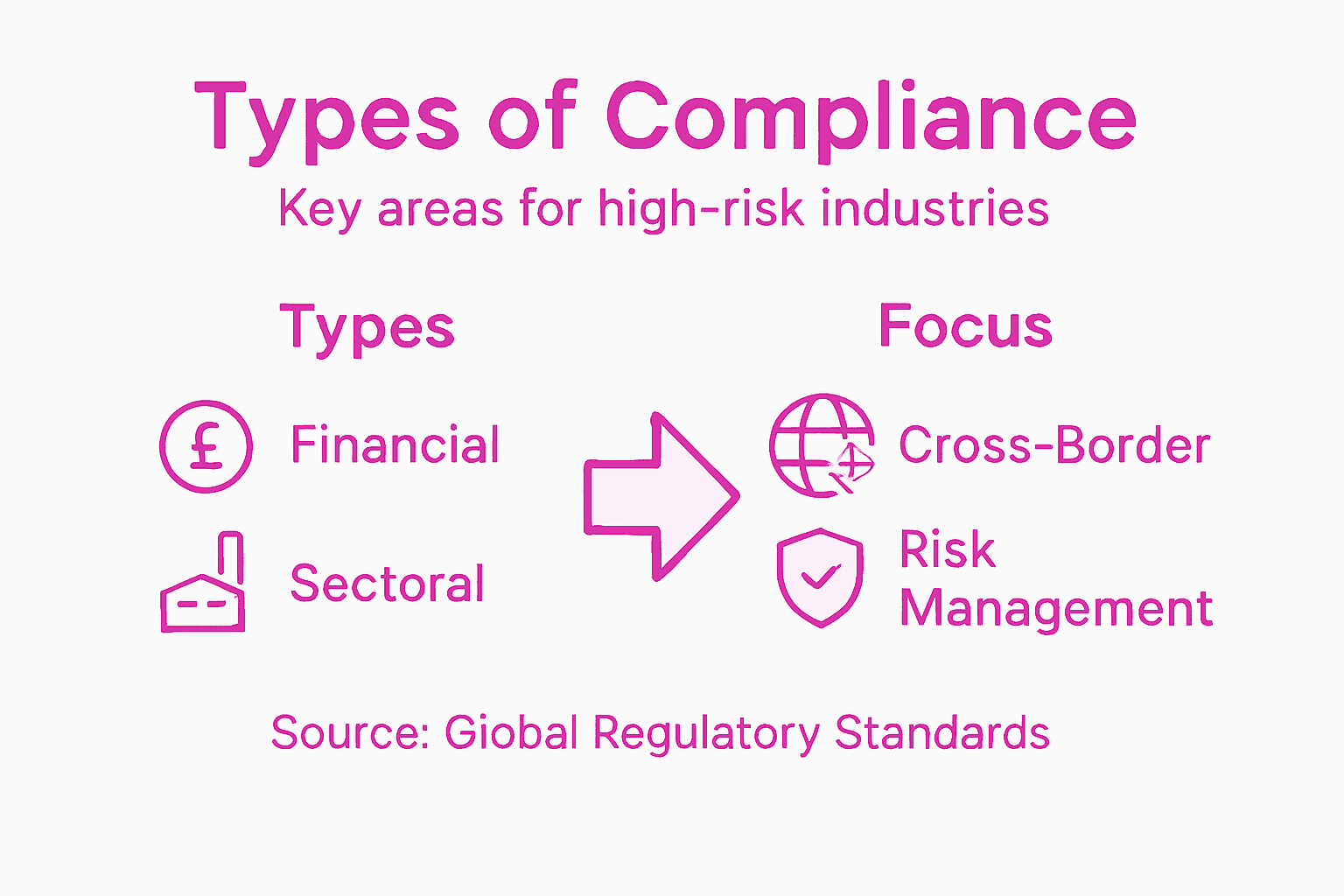
Compliance frameworks are multifaceted, encompassing three primary categories that protect organisations operating in high-risk sectors: financial, sectoral, and cross-border compliance. Cross-border compliance strategies have become increasingly sophisticated, addressing complex international regulatory challenges across diverse legal environments.
Financial Compliance focuses on ensuring organisations adhere to monetary regulations, anti-money laundering (AML) protocols, know your customer (KYC) requirements, and financial reporting standards. This type of compliance is particularly critical in banking, investment, and financial technology sectors, where regulatory scrutiny remains intense and potential penalties for non-compliance can be substantial.
Sectoral Compliance involves industry-specific regulatory requirements tailored to unique operational landscapes. Each sector – whether gambling, cryptocurrency, financial services, or digital platforms – has distinct compliance obligations. These regulations address sector-specific risks, operational standards, consumer protections, and governance frameworks that ensure ethical and legal business practices.
Cross-Border Compliance represents the most complex regulatory challenge, requiring organisations to navigate multiple jurisdictional legal frameworks simultaneously. This approach demands:
Understanding diverse international regulatory requirements
Implementing flexible compliance mechanisms
Developing adaptable risk management strategies
Maintaining comprehensive documentation
Ensuring consistent regulatory alignment across different markets
By integrating these three compliance dimensions, organisations can create robust risk management frameworks that protect against legal vulnerabilities and support sustainable international growth.
The following table compares the three main compliance types across key dimensions:
Compliance Type | Primary Focus | Main Challenge | Typical Industry Examples |
Financial | Monetary regulations, AML, KYC | Addressing financial crime | Banking, fintech, investment |
Sectoral | Industry-specific requirements | Rapid regulatory changes | Gambling, cryptocurrency, digital |
Cross-Border | Multi-jurisdictional laws | Harmonising global standards | International trade, e-commerce |
Pro tip: Develop a centralised compliance dashboard that tracks regulatory changes across different jurisdictions, enabling real-time updates and proactive risk management strategies.
Legal Frameworks and Key International Standards
International legal standards form the backbone of global regulatory compliance, creating a unified approach to managing complex cross-border business challenges. International legal frameworks establish critical mechanisms for ensuring ethical practices, transparency, and accountability across diverse jurisdictional boundaries.
Key international organisations play pivotal roles in developing and enforcing these comprehensive standards. The United Nations, World Trade Organisation, and International Labour Organization collaborate to create multilateral conventions that address crucial areas such as anti-corruption, human rights, labour practices, and financial transparency. These frameworks provide structured guidelines that help organisations navigate the intricate landscape of global regulatory requirements, particularly in high-risk sectors like financial services, gambling, and digital platforms.
The most significant international legal standards encompass several critical domains:
Anti-Money Laundering (AML) protocols
Know Your Customer (KYC) regulations
Data protection and privacy standards
Corporate governance frameworks
Environmental and social responsibility guidelines
Intellectual property protection mechanisms
Effective implementation of these standards requires organisations to develop robust compliance strategies that are both adaptable and comprehensive. This involves continuous monitoring of regulatory changes, investing in staff training, and creating flexible internal policies that can quickly respond to evolving international legal requirements.
Pro tip: Implement a quarterly regulatory review process that systematically tracks international legal updates and assesses their potential impact on your organisation’s compliance strategy.
Common Risks and Penalties for Non-Compliance
Non-compliance represents a significant threat to organisations operating in high-risk sectors, with potential consequences extending far beyond immediate financial penalties. Cost of non-compliance can be catastrophic, encompassing legal liabilities, reputational damage, and substantial operational disruptions that may ultimately threaten an organisation’s entire business model.

The financial implications of regulatory breaches are profound and multifaceted. Organisations can face astronomical fines ranging from thousands to hundreds of millions of pounds, depending on the severity and scope of the violation. These penalties are not merely punitive but designed to deter future misconduct and demonstrate the critical importance of maintaining rigorous compliance standards across financial services, gambling, cryptocurrency, and other high-risk industries.
Key risks associated with non-compliance include:
Substantial monetary penalties and legal sanctions
Permanent loss of operational licences
Mandatory business restructuring
Criminal prosecutions for senior executives
Permanent reputational damage
Potential bankruptcy or business closure
Increased scrutiny from regulatory bodies
Beyond direct financial penalties, non-compliance can trigger a cascade of secondary consequences. These include loss of stakeholder trust, difficulty securing future investments, increased insurance premiums, reduced market valuation, and potential contractual breaches. The long-term economic impact often far exceeds the immediate regulatory fines, potentially rendering entire business models unsustainable.
Here is a summary of the primary consequences organisations may face from non-compliance:
Risk Category | Example Impact | Business Consequence |
Financial Penalties | Large regulatory fines | Reduced capital and cash reserves |
Legal Sanctions | Court-mandated operational changes | Compulsory restructuring |
Reputational Damage | Negative media coverage | Eroded stakeholder trust |
Executive Liability | Criminal prosecution of management | Leadership instability |
Market Impact | Licence loss or business closure | Exit from key markets |
Pro tip: Conduct comprehensive quarterly compliance audits that systematically review all regulatory requirements and proactively identify potential areas of vulnerability before they escalate into significant legal challenges.
Building a Culture of Compliance Across Operations
Building a robust compliance culture requires more than superficial policy implementation; it demands a comprehensive, strategic approach that integrates ethical principles into every organisational layer. Compliance culture fundamentals emphasise creating an environment where regulatory adherence becomes an intrinsic part of organisational DNA, transcending mere procedural requirements.
Leadership plays a pivotal role in establishing and maintaining this culture. Senior executives must demonstrate unwavering commitment to compliance, actively communicating its importance and modelling ethical behavior. This involves transparent communication, consistent enforcement of standards, and creating mechanisms that empower employees to raise concerns without fear of retribution. By embedding compliance into performance evaluations, compensation structures, and strategic decision-making, organisations can transform regulatory adherence from a bureaucratic exercise into a core business value.
Key strategies for developing a comprehensive compliance culture include:
Developing clear, accessible compliance policies
Implementing ongoing training and education programmes
Creating transparent reporting mechanisms
Establishing accountability at all organisational levels
Integrating compliance metrics into performance evaluations
Fostering an open communication environment
Regularly updating policies to reflect evolving regulatory landscapes
Successful compliance cultures recognise that regulatory adherence is not a static concept but a dynamic, evolving process requiring continuous learning, adaptation, and organisational commitment. By treating compliance as a strategic advantage rather than a mere regulatory requirement, high-risk sectors can build resilience, trust, and sustainable operational frameworks.
Pro tip: Develop a comprehensive compliance scorecard that tracks individual and departmental performance against key regulatory metrics, creating a data-driven approach to embedding compliance culture.
Navigate Complex Global Compliance with Confidence
High-risk sectors face constant challenges in meeting evolving global compliance demands. The risks of non-compliance outlined in the article — including hefty fines, licence loss, and reputational damage — highlight the critical need for expert legal support that understands multi-jurisdictional frameworks such as fintech, crypto, and gambling. Your goal is clear: build robust, adaptive compliance strategies that protect your business and accelerate international growth.
At NUR Legal, we specialise in guiding startups and established companies through this complex landscape. From securing reliable crypto licenses in Georgia and Seychelles to obtaining fast, affordable gaming licences in Curaçao and Anjouan, our comprehensive services cover every legal angle. Our deep relationships with regulators empower you to confidently implement effective compliance programmes and reduce legal risk across markets.
Take control of your global compliance today with trusted expertise designed specifically for high-risk industries. Visit NUR Legal now to explore tailored licensing solutions, legal opinions, and company formation services that transform compliance challenges into growth opportunities. Do not wait until non-compliance threatens your business stability—partner with us to secure your future.
Frequently Asked Questions
What is global compliance in high-risk sectors?
Global compliance in high-risk sectors refers to a strategic approach that ensures organisations adhere to various regulatory frameworks and legal requirements across multiple jurisdictions. It involves managing legal risks through robust policies, employee training, and continuous monitoring.
Why is compliance important in financial and cryptocurrency sectors?
Compliance is crucial in financial and cryptocurrency sectors because these industries face intense regulatory scrutiny. Adhering to compliance standards helps prevent legal penalties, reputational damage, and operational disruptions that can arise from non-compliance.
What are the main components of an effective global compliance strategy?
An effective global compliance strategy includes comprehensive regulatory mapping, risk assessment protocols, regular audits, continuous employee training, and technology-enabled monitoring systems to stay aligned with international regulations.
What are the potential consequences of non-compliance?
Consequences of non-compliance can include substantial monetary fines, legal sanctions, reputational damage, loss of operational licences, and even criminal prosecutions for executives. The long-term implications may threaten an organisation’s business model significantly.
Recommended


Comments