
How to Ensure Compliance 2025 for High-Risk Industries


More than 60 percent of compliance officers at British fintech firms say staying ahead of international regulations will be their biggest challenge by 2025. With global regulatory frameworks in constant flux, overlooking new rules can lead to costly licensing delays and operational risks. This guide breaks down evolving requirements and risk mapping strategies, giving you practical tools to safeguard your crypto or fintech startup against the shifting demands facing high-risk industries worldwide.
Table of Contents
Quick Summary
Key Insight | Explanation |
1. Comprehensive regulatory assessment for 2025 | Conduct a thorough review of international frameworks to anticipate and adapt to emerging regulations in high-risk sectors by 2025. |
2. Develop jurisdiction-specific risk mapping | Create a systematic approach to identify and manage risks tailored to the unique regulatory landscape of your operational regions. |
3. Implement robust internal controls | Establish documented policies and accountability mechanisms that align with international standards to enhance compliance across the organisation. |
4. Create a centralised compliance repository | Develop a dynamic system for tracking compliance activities and changes, ensuring continuous visibility and documentation accuracy in your organisation. |
5. Prepare for targeted regulatory audits | Formulate a comprehensive audit readiness framework, including documentation and accountability strategies, to demonstrate compliance and operational excellence. |
Step 1: Assess evolving 2025 regulatory requirements
Evaluating regulatory requirements for high-risk industries demands a strategic and proactive approach. Your comprehensive assessment will involve analysing key global trends and preparing your organisation for potential regulatory shifts in 2025.
To effectively assess emerging regulatory landscapes, start by conducting a thorough review of international policy frameworks. The OECD regulatory policy outlook highlights critical insights into governments upgrading their regulatory capacities. Focus on understanding risk-based approaches that prioritise higher-risk activities across digital and green transition sectors. This means examining cybersecurity protocols, artificial intelligence governance, and financial control mechanisms that will likely become more stringent.
Key assessment strategies include mapping current regulatory requirements against projected 2025 standards, identifying potential compliance gaps, and developing adaptive frameworks. Regulatory compliance insights from KPMG suggest intensified supervision activities, particularly in cybersecurity and AI-related domains. Your assessment should incorporate state-level regulatory variations, international compliance standards, and sector-specific requirements.
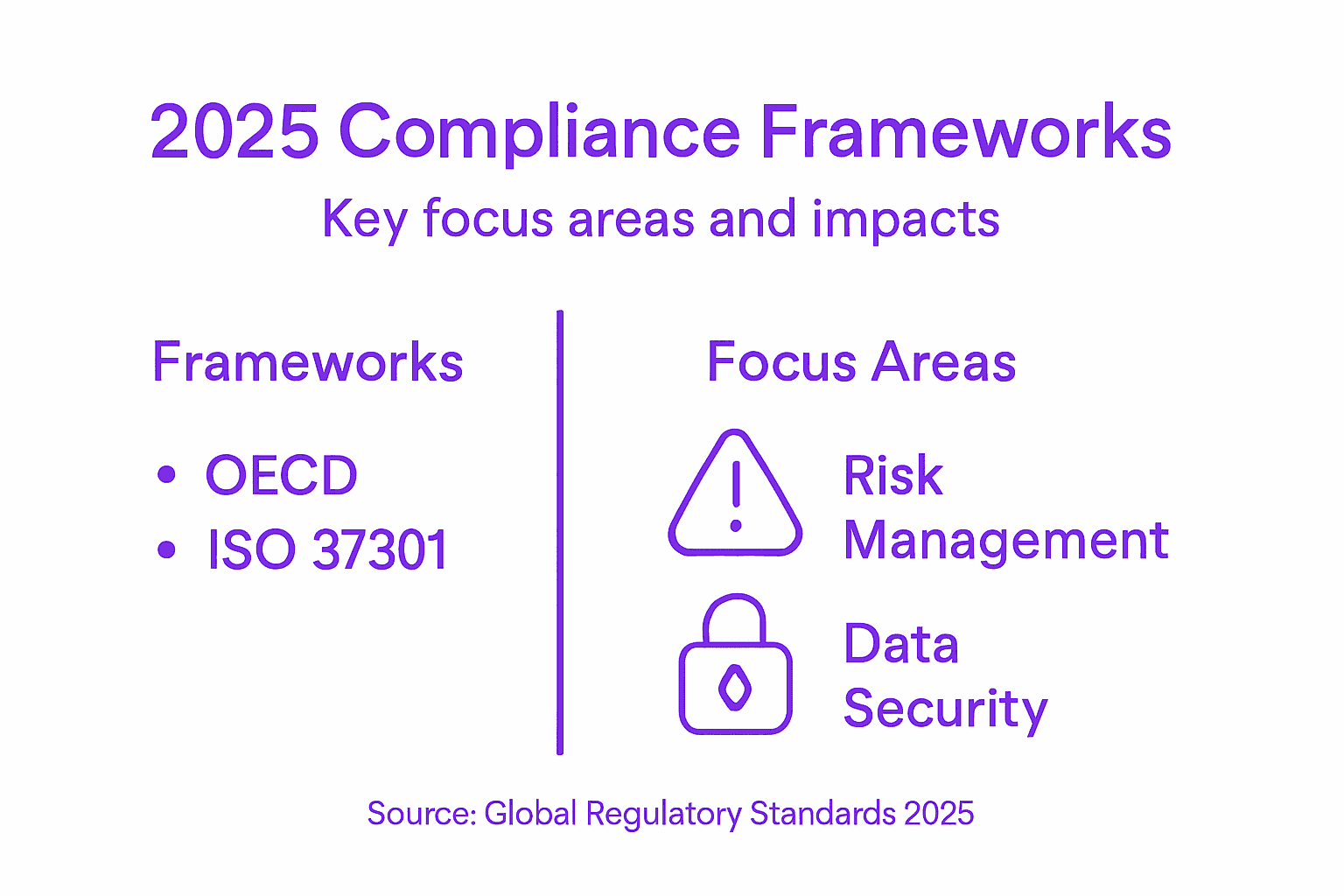
Here is a comparison of key international regulatory frameworks relevant for 2025 compliance assessment:
Framework | Focus Area | Impact on High-Risk Sectors |
OECD Regulatory Policy | Risk-based regulation | Emphasises digital and green transitions |
COSO Internal Control | Control environment | Strengthens governance for financial institutions |
ISO 31000 Risk Management | Risk identification | Supports proactive risk mitigation strategies |
EU Digital Governance | Cybersecurity protocols | Drives compliance in technology industries |
Top recommendation: Establish a dedicated compliance working group that meets quarterly to track and analyse regulatory changes, ensuring your organisation remains ahead of emerging compliance requirements.
Step 2: Map critical compliance risks for your jurisdiction
Maintaining regulatory compliance requires a sophisticated approach to identifying and managing jurisdiction specific risks. Your primary goal is to develop a comprehensive risk mapping strategy that anticipates potential regulatory challenges across different operational domains.
Global regulatory changes demonstrate increasing complexity in compliance landscapes. Understanding jurisdiction specific nuances becomes crucial for organisations operating in high risk sectors. This means conducting detailed assessments of regional regulatory frameworks, examining specific requirements in banking, ESG reporting, and technological governance across different geographical contexts. Pay particular attention to emerging regulations in financial services, technology sectors, and cross border operational environments.
To effectively map compliance risks, organisations must develop a systematic approach that incorporates multiple analytical perspectives. Regulatory environment analysis reveals that geopolitical shifts and regional variations significantly impact compliance requirements. Focus on creating a dynamic risk assessment framework that can adapt to changing regulatory landscapes, incorporating continuous monitoring mechanisms and scenario planning techniques.
Expert suggestion: Develop a quarterly regulatory risk assessment protocol that includes external legal consultations and comprehensive documentation of emerging compliance shifts in your specific operational jurisdictions.
Step 3: Implement robust internal control frameworks
Developing a comprehensive internal control framework is critical for organisations navigating complex regulatory environments. Your objective is to create a systematic approach that effectively identifies, assesses, and mitigates potential compliance risks across your operational landscape.

Strategic risk management approaches demonstrate the importance of aligning internal controls with internationally recognised standards such as COSO and ISO 31000. This requires developing documented policies that address specific regulatory requirements, establishing clear accountability mechanisms, and implementing ongoing audit processes. Your framework should incorporate automated monitoring systems that can track regulatory changes and flag potential compliance vulnerabilities in real time.
Effective internal control implementation demands a holistic approach that integrates risk governance across multiple organisational levels. Comprehensive control strategies emphasise the need for operational resilience and robust data security measures. Focus on creating a dynamic framework that can adapt to evolving regulatory landscapes, with clear escalation protocols, regular risk assessments, and continuous staff training programmes that ensure everyone understands their compliance responsibilities.
Expert suggestion: Develop a centralised compliance dashboard that provides real time visibility into your organisation’s internal control performance and highlights potential regulatory risks before they become critical issues.
The following table summarises how robust internal controls benefit regulatory compliance:
Internal Control Feature | Business Impact | Compliance Advantage |
Automated monitoring | Immediate risk alerts | Early detection of non-compliance |
Documented policies | Standardised processes | Evident audit trail for regulators |
Regular staff training | Increased awareness | Reduces accidental violations |
Centralised dashboard | Holistic oversight | Consolidates compliance metrics |
Step 4: Document and monitor ongoing compliance activities
Establishing a robust documentation and monitoring system is crucial for maintaining regulatory compliance across high-risk industries. Your primary objective is to create a systematic approach that captures, tracks, and evaluates compliance activities with precision and consistency.
Regulatory documentation strategies emphasise the importance of developing comprehensive written guidelines that capture every aspect of your compliance framework. This involves creating detailed documentation that outlines policies, procedures, risk assessments, and audit trails. Your documentation should be dynamic, allowing for regular updates that reflect changing regulatory landscapes and organisational shifts.
Compliance monitoring technologies are evolving to provide more sophisticated tracking mechanisms. Implement key risk indicators that enable real time monitoring of compliance performance, utilising automated systems to detect potential deviations quickly. Focus on developing a comprehensive tracking methodology that includes regular internal audits, periodic risk assessments, and transparent reporting mechanisms that provide clear visibility into your organisation’s compliance status.
Expert suggestion: Create a centralised compliance repository with version controlled documentation and automated alert systems that notify key stakeholders about any significant regulatory changes or potential compliance risks.
Step 5: Verify adherence with targeted regulator audits
Preparing for targeted regulatory audits requires a strategic and comprehensive approach that demonstrates your organisation’s commitment to compliance and operational excellence. Your primary goal is to develop robust evidence gathering and presentation techniques that effectively showcase your regulatory readiness.
Regulatory audit preparedness has become increasingly complex, with regulators focusing intensely on cybersecurity, operational resilience, and data protection frameworks. This means developing a meticulous documentation strategy that provides transparent insights into your governance mechanisms, risk management protocols, and compliance infrastructure. Anticipate detailed scrutiny of your internal controls, particularly in high risk areas such as critical infrastructure and sensitive data management.
Risk based compliance approaches recommend creating a comprehensive audit preparation framework that allows for strategic resource allocation. This involves conducting internal pre audit assessments, developing comprehensive response protocols, and maintaining a continuous state of audit readiness. Your preparation should include detailed documentation trails, clear accountability mechanisms, and demonstrable evidence of proactive regulatory engagement.
Expert suggestion: Develop a dynamic audit response toolkit that includes pre prepared documentation sets, clear escalation protocols, and a designated compliance response team capable of providing immediate and comprehensive information during regulatory examinations.
Navigate 2025 Compliance Challenges with Confidence
High-risk industries face growing pressure to align with stringent 2025 regulatory requirements such as risk-based approaches in digital transformation and cybersecurity governance. Organisations often struggle with mapping jurisdiction-specific compliance risks, implementing robust internal controls, and preparing for demanding regulator audits. The complexity can feel overwhelming when failing to keep pace means costly penalties or operational setbacks.
NUR Legal specialises in easing these challenges. Our tailored legal consultancy services help fintech, crypto, and gaming businesses secure essential licenses including Crypto Licenses in Georgia and Seychelles and Full Gaming Licensing in Curaçao and Anjouan. We partner with you to establish rigorous compliance frameworks that reflect international standards like ISO 31000 and COSO, ensuring your internal controls are audit-ready and regulatory risks are continuously managed.
Start building your compliance resilience today with trusted expertise that keeps you ahead of regulatory shifts. Visit NUR Legal to explore how our comprehensive licensing and legal support can empower your operation. Act now to secure the support you need before 2025 regulatory demands take full effect.
Frequently Asked Questions
How can I assess the evolving regulatory requirements for 2025?
To assess the evolving regulatory requirements for 2025, start by conducting a thorough review of international policy frameworks. Identify key global trends and compare your current compliance measures against projected standards to spot potential gaps.
What strategies can I use to map compliance risks specific to my jurisdiction?
To map compliance risks specific to your jurisdiction, develop a systematic approach that includes detailed assessments of regional regulatory frameworks. Conduct this analysis quarterly to adapt to any changes and maintain awareness of jurisdiction-specific challenges.
How should I develop an internal control framework for compliance?
To develop an internal control framework, align your policies with internationally recognised standards like COSO and ISO 31000. Implement clear accountability mechanisms and ensure regular audits to track compliance and quickly address any vulnerabilities.
What documentation practices should I implement for ongoing compliance monitoring?
Implement comprehensive and precise documentation practices by capturing all compliance activities in a centralised repository. Update your guidelines regularly to reflect evolving regulations and create automated alert systems for significant compliance changes.
How can I prepare for targeted regulatory audits effectively?
To prepare for targeted regulatory audits, create a meticulous documentation strategy that showcases your organisation’s compliance readiness. Conduct internal pre-audit assessments and develop a designated compliance response team to ensure immediate access to necessary information during audits.
Recommended


Comments