
Regulatory Frameworks for Crypto: Ensuring Global Compliance


Most british crypto startups face mounting regulatory pressure as global enforcement actions surge past $1.23 billion in penalties in only six months. For founders and compliance officers, securing licences in high-risk jurisdictions is fraught with uncertainty, especially when European frameworks differ sharply from Asian or American rules. This guide clarifies the practical steps and key risks you must consider to build compliance strategies that withstand international scrutiny and protect your business.
Table of Contents
Key Takeaways
Point | Details |
Regulatory Frameworks are Essential | Effective cryptocurrency regulations are crucial for ensuring financial stability and protecting market participants. Frameworks should address AML, KYC, and compliance standards. |
Jurisdictional Differences | The regulatory landscape varies significantly across regions, with the European Union focusing on harmonisation and Asia-Pacifying adopting specific rules. Understanding local regulations is key. |
Compliance is Paramount | Comprehensive and adaptive compliance strategies are necessary to navigate the intricate regulatory environment and avoid severe penalties. Regular audits and ongoing monitoring can enhance compliance. |
Dynamic Strategies Required | Firms must develop flexible compliance frameworks that can quickly adapt to changing regulations, ensuring proactive engagement with authorities and thorough documentation. |
Defining Regulatory Frameworks for Crypto
Cryptocurrency regulatory frameworks represent complex systems designed to manage digital financial technologies within existing legal infrastructures. These frameworks aim to address the unique challenges presented by decentralised digital assets, ensuring financial stability and protecting market participants. Global regulatory approaches demonstrate significant variability across jurisdictions, reflecting the nuanced responses required by emerging technological innovations.
The primary objectives of crypto regulatory frameworks centre on establishing clear guidelines for digital asset management, preventing financial crimes, and creating standardised compliance mechanisms. These frameworks typically address critical areas such as anti-money laundering (AML) protocols, know-your-customer (KYC) requirements, taxation policies, and consumer protection standards. The Financial Stability Board recommends a technology-neutral approach that focuses on underlying risks rather than specific digital asset characteristics.
Key components of effective crypto regulatory frameworks include comprehensive legal definitions, robust monitoring systems, and adaptable governance structures. Jurisdictions must balance innovation support with rigorous risk management, creating regulatory environments that protect investors while enabling technological advancement. This requires ongoing collaboration between financial authorities, technology experts, and legal professionals to develop responsive and intelligent regulatory mechanisms.
Pro tip: Develop a dynamic compliance strategy that anticipates regulatory shifts and incorporates flexible technological infrastructure to accommodate evolving legal requirements.
Jurisdictional Variations and Key Global Trends
The global cryptocurrency regulatory landscape demonstrates remarkable diversity, with each jurisdiction developing unique approaches to managing digital assets. Global crypto regulation trends reveal significant variations in legal frameworks, reflecting distinct national priorities, economic environments, and technological readiness.
Regional approaches to crypto regulation exhibit pronounced differences. The European Union has pursued a more harmonised strategy through the Markets in Crypto-Assets (MiCA) framework, seeking standardised rules across member states. In contrast, Asian markets like Singapore and Japan have implemented more granular, technology-specific regulations, while jurisdictions in the Americas display a spectrum of approaches ranging from progressive regulatory environments in places like Colorado to more restrictive frameworks in other regions.
Key global trends indicate a convergence towards more structured regulatory environments, with international collaborative efforts focusing on consumer protection, financial stability, and anti-money laundering protocols. Emerging regulatory frameworks increasingly emphasise comprehensive risk management, transparent compliance mechanisms, and adaptive governance structures that can accommodate rapid technological innovation in the digital asset ecosystem.
Here is a summary of how different regions approach cryptocurrency regulation:
Region | Regulatory Strategy | Level of Harmonisation | Notable Characteristics |
European Union | MiCA framework | High | Standardised rules, cross-border |
Asia-Pacific | Technology-specific rules | Moderate | Tailored, innovation-friendly |
Americas | Varied approaches | Low to moderate | Progressive to restrictive |
Pro tip: Develop a flexible compliance strategy that can quickly adapt to varying international regulatory requirements while maintaining core principles of transparency and risk management.
Core Compliance, Licensing, and Reporting Rules
The evolving landscape of cryptocurrency regulation demands comprehensive compliance frameworks that address multiple complex dimensions of digital asset management. Cryptocurrency regulatory compliance now requires sophisticated institutional-grade approaches that integrate technological solutions with robust legal mechanisms, transforming regulatory adherence into a strategic business advantage.
Core compliance requirements universally encompass three critical pillars: Know Your Customer (KYC) protocols, Anti-Money Laundering (AML) procedures, and comprehensive transaction reporting mechanisms. Different jurisdictions implement these requirements with varying degrees of stringency, but fundamental expectations remain consistent. Organisations must develop sophisticated identity verification systems, implement rigorous transaction monitoring protocols, and maintain meticulous records that demonstrate ongoing regulatory alignment.

Licensing frameworks represent another crucial aspect of regulatory compliance, with requirements varying dramatically across different geopolitical regions. European Union regulations like Markets in Crypto-Assets (MiCA) establish standardised licensing requirements, while jurisdictions in the Americas and Asia-Pacific develop more nuanced, context-specific frameworks. Global compliance guidelines emphasise the importance of developing adaptive compliance strategies that can rapidly respond to evolving regulatory landscapes and jurisdiction-specific requirements.
Pro tip: Invest in flexible technological infrastructure and compliance management systems that can dynamically adapt to changing international regulatory standards while maintaining comprehensive documentation.
High-Risk Jurisdictions: Special Regulatory Challenges
Cryptocurrency regulatory landscapes reveal significant complexity within high-risk jurisdictions, characterised by inconsistent governance and substantial compliance challenges. Jurisdictional risk assessment requires sophisticated due diligence to navigate the intricate regulatory environments that present elevated financial crime and regulatory arbitrage risks.
High-risk jurisdictions typically demonstrate systemic vulnerabilities in regulatory oversight, particularly concerning Virtual Asset Service Providers (VASPs). Weak anti-money laundering (AML) controls, incomplete implementation of international compliance standards, and limited enforcement mechanisms create substantial operational risks for cryptocurrency businesses. Organisations must develop robust risk mitigation strategies that include enhanced transaction monitoring, comprehensive identity verification protocols, and proactive regulatory engagement.
Persistent compliance gaps in virtual asset regulation underscore the critical need for advanced technological and legal frameworks. Decentralised finance (DeFi) platforms and stablecoin ecosystems face particular scrutiny, with international bodies like the Financial Action Task Force (FATF) continually advocating for more stringent global standards to address emerging financial crime risks and maintain market integrity.
Pro tip: Develop a dynamic compliance framework with jurisdiction-specific modules that can rapidly adapt to changing regulatory requirements and integrate advanced technological monitoring solutions.
Cost, Risk, and Penalties for Non-Compliance
The cryptocurrency regulatory landscape has transformed dramatically, with financial penalties for non-compliance escalating to unprecedented levels. Global enforcement actions have resulted in over $1.23 billion in sanctions during the first half of 2025, signalling a dramatically increased regulatory commitment to maintaining market integrity and protecting investor interests.
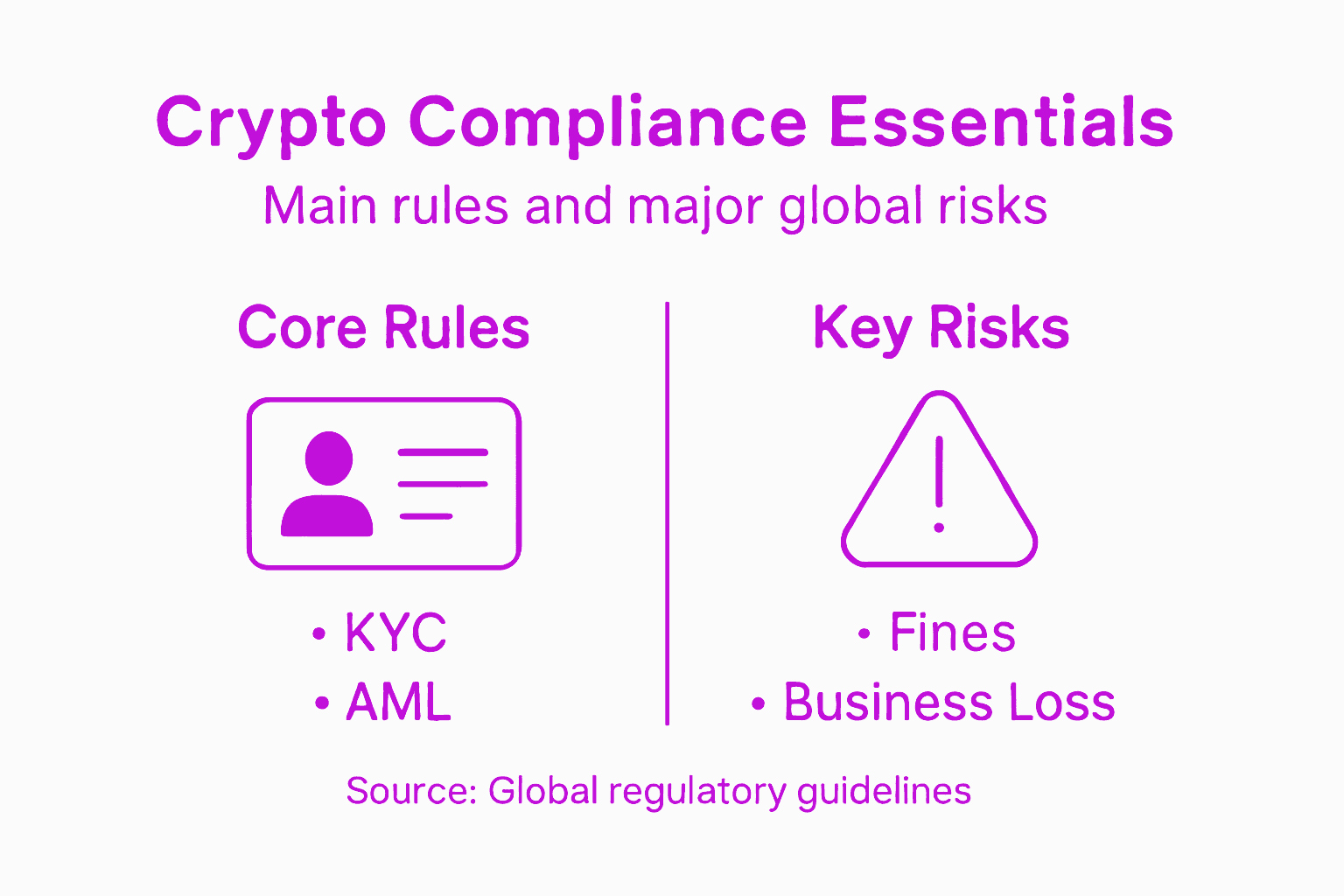
Non-compliance risks extend far beyond immediate financial penalties, encompassing comprehensive operational disruptions and long-term reputational damage. Regulatory bodies like the Securities and Exchange Commission (SEC) have intensified enforcement mechanisms, targeting unregistered securities, anti-money laundering (AML) violations, and know-your-customer (KYC) failures. Regulatory enforcement strategies now include severe consequences such as substantial fines, potential criminal charges, and complete business shutdown risks.
Cryptocurrency organisations must understand that non-compliance penalties are multifaceted, involving not just financial sanctions but also potential legal repercussions, loss of operational licences, and permanent reputational damage. The complexity of international regulatory frameworks demands sophisticated, adaptive compliance strategies that can navigate the intricate landscape of global financial regulations, anticipate potential regulatory shifts, and maintain robust internal control mechanisms.
The following table outlines the main impacts of non-compliance for crypto organisations:
Non-Compliance Risk | Consequence | Business Impact |
Financial penalties | Large fines | Reduced profitability |
Regulatory enforcement | Business shutdown | Loss of operating licence |
Reputational damage | Loss of trust | Difficulty attracting investors |
Pro tip: Develop a comprehensive compliance risk assessment framework that includes ongoing monitoring, regular internal audits, and proactive engagement with regulatory updates across multiple jurisdictions.
Best Practices for Securing Crypto Licences
Securing cryptocurrency licences requires a strategic, comprehensive approach that encompasses multiple regulatory dimensions. Crypto regulatory compliance demands meticulous preparation, involving sophisticated legal frameworks, robust documentation, and proactive engagement with regulatory authorities across different jurisdictions.
Successful licence acquisition necessitates developing sophisticated anti-money laundering (AML) and know-your-customer (KYC) protocols that demonstrate organisational commitment to financial integrity. Firms must prepare comprehensive documentation showcasing financial solvency, cybersecurity infrastructure, and transparent operational mechanisms. Crypto exchange licensing processes require detailed applications that comprehensively outline business activities, risk management strategies, and compliance monitoring mechanisms.
Strategic jurisdiction selection represents a critical factor in licence procurement, with organisations needing to evaluate regulatory environments based on maturity, operational flexibility, and alignment with business objectives. This involves conducting thorough jurisdictional risk assessments, understanding specific regulatory requirements, and developing adaptable compliance frameworks that can evolve with changing international standards. Successful applicants invest significant resources in professional legal consultation and maintain ongoing dialogue with regulatory bodies.
Pro tip: Develop a dynamic compliance roadmap that integrates jurisdiction-specific requirements, maintains comprehensive documentation, and establishes proactive communication channels with regulatory authorities.
Navigate Complex Crypto Regulations with Confidence
The evolving global regulatory landscape for cryptocurrency presents significant challenges including stringent compliance requirements, licensing nuances, and jurisdictional variation. Businesses seeking clear guidance on anti-money laundering protocols, KYC obligations, and adaptive governance must act decisively to prevent costly penalties and operational disruption. Understanding terms like MiCA, VASPs, and jurisdiction-specific licensing frameworks is essential but can be overwhelming without specialised support.
At NUR Legal, we specialise in providing tailored legal consultancy focused on high-risk, regulated industries such as crypto and fintech. Our expert services include securing crypto licences in key jurisdictions like Georgia and Seychelles and offering comprehensive compliance solutions designed to align with dynamic international frameworks. Don’t let regulatory uncertainty stall your growth—visit NUR Legal now to begin building a resilient and legally sound operation. Explore our offerings in crypto licensing and benefit from trusted advice that keeps you ahead in a fast-changing market.
Frequently Asked Questions
What are the main objectives of cryptocurrency regulatory frameworks?
The primary objectives of cryptocurrency regulatory frameworks include establishing clear guidelines for digital asset management, preventing financial crimes, and creating standardised compliance mechanisms to ensure investor protection and financial stability.
How do compliance requirements for crypto organisations differ across jurisdictions?
Compliance requirements, such as Know Your Customer (KYC) and Anti-Money Laundering (AML) protocols, can vary significantly among jurisdictions. Each region may implement these requirements with different levels of stringency, necessitating sophisticated compliance strategies tailored to each jurisdiction’s regulations.
What are the risks associated with non-compliance in cryptocurrency regulations?
Non-compliance risks can lead to substantial financial penalties, regulatory enforcement actions that may result in business shutdowns, and severe reputational damage, making it critical for cryptocurrency organisations to maintain robust compliance frameworks.
How can cryptocurrency firms secure the necessary licences for operation?
To secure cryptocurrency licences, firms need to develop comprehensive AML and KYC protocols, ensure strong cybersecurity measures, and prepare detailed documentation outlining their business activities and compliance mechanisms, while also engaging proactively with regulatory authorities.
Recommended



Comments