
Contract Review: Safeguarding High-Risk Business Deals


Every british business faces the constant challenge of protecting its legal interests when entering agreements. Around 45 percent of companies admit they have experienced costly disputes due to overlooked contract details. With complex contracts becoming more common across the United Kingdom and beyond, careful contract review is not just advisable, it is critical. This article unpacks what legal contract review truly involves, highlighting the steps, risks, and expert guidance that help british organisations avoid expensive mistakes.
Table of Contents
Key Takeaways
Point | Details |
Importance of Contract Review | Rigorous contract reviews are essential for identifying legal risks and ensuring compliance in business transactions. |
Technological Integration | Leveraging advanced tools can enhance the efficiency and accuracy of the review process, particularly in high-volume scenarios. |
High-Risk Contract Types | Certain contracts, such as those in construction and financial services, require more thorough scrutiny due to their complexity and regulatory implications. |
Ongoing Compliance Management | Establishing robust compliance frameworks and continuous review protocols is crucial for adapting to changing legal landscapes. |
What Contract Review Involves Legally
Legal contract review represents a meticulous process of systematically examining legal agreements to protect business interests and mitigate potential risks. At its core, contract review involves comprehensive analysis of contractual language, terms, obligations, and potential legal exposures that could impact an organisation’s operational and financial landscape.
The BaFiCoRe Framework demonstrates a structured approach to contract examination, highlighting critical stages including initial document assessment, risk identification, compliance verification, and comprehensive legal interpretation. Professionals performing contract reviews typically scrutinise multiple dimensions: precise legal terminology, potential ambiguities, financial implications, regulatory alignment, and potential liability scenarios.
Modern contract review increasingly leverages advanced technological tools, with emerging research comparing large language models against traditional legal reviewers to enhance accuracy and efficiency. Key components of a rigorous contract review process encompass:
Detailed clause-by-clause examination
Assessment of contractual risks and potential legal vulnerabilities
Verification of compliance with organisational policies
Evaluation of financial and operational implications
Identification of potential negotiation points
Pro Tip for Contract Review: Always engage a qualified legal professional to conduct a final review, as technological tools and frameworks cannot fully replace nuanced human legal expertise.
The ultimate objective of contract review remains consistent: safeguarding your business’s legal and financial interests through meticulous, systematic examination of contractual documentation.
Here’s a quick comparison of traditional versus technology-assisted contract review approaches:
Aspect | Traditional Review | Technology-Assisted Review |
Speed | Often time-consuming | Significantly expedited |
Consistency | Varies by professional | High, driven by automation |
Human Judgement | Nuanced, context-aware | Limited, mainly rules-based |
Ideal Use Case | Complex, ambiguous contracts | High-volume or standard documents |
Error Detection | Relies on experience | Pattern-based and exhaustive |
Types of Contracts Needing Review
In high-risk business sectors, certain types of contracts demand more rigorous and comprehensive legal scrutiny. Contract reviews become particularly critical when dealing with complex agreements that involve significant financial, operational, or regulatory implications across specialised industries.
Legal analysis of defaults in house building contracts underscores the paramount importance of detailed contract reviews, especially in industries prone to intricate legal challenges. High-risk sectors requiring meticulous contract examination include:
Construction Contracts: Complex agreements with multiple stakeholders
Financial Service Agreements: Involving intricate regulatory compliance requirements
Technology and Software Licensing Contracts: Protecting intellectual property rights
International Business Collaboration Agreements: Navigating cross-border legal complexities
Gambling and Gaming Operational Contracts: Ensuring regulatory alignment
Cryptocurrency and Blockchain Engagement Contracts: Managing emerging technological legal frameworks
Research on knowledge-augmented language models for contract risk identification highlights the sophisticated technological approaches now available to enhance contract review processes. These technological advancements are particularly valuable in sectors with high legal complexity and substantial financial stakes.

Specialised contract reviews become critical in preventing potential legal disputes, financial losses, and regulatory non-compliance. Each contract type presents unique challenges requiring targeted legal expertise and comprehensive examination of potential risks and obligations.
Pro Tip for Contract Selection: Prioritise contracts involving substantial financial investments, cross-border transactions, or complex regulatory environments for the most thorough legal review.
Core Steps in the Contract Review Process
The contract review process demands a structured and methodical approach to mitigate legal risks and ensure comprehensive understanding of contractual obligations. Legal contract review represents a complex procedure that requires systematic examination and strategic analysis of every contractual element.
The BaFiCoRe Framework details a comprehensive contract review lifecycle which encompasses several critical stages designed to provide robust legal protection. These stages include initial document assessment, risk identification, and implementation of strategic approval workflows. Professionals typically follow a structured sequence of steps to conduct thorough contract reviews:
Initial Document Gathering
Collect all relevant contract documents
Verify document completeness and authenticity
Confirm all parties’ authorised signatures
Preliminary Legal Assessment
Identify contract type and legal jurisdiction
Analyse fundamental contractual terms
Assess potential legal risks and compliance requirements
Detailed Clause Examination
Scrutinise each contractual clause meticulously
Evaluate language precision and potential ambiguities
Cross-reference terms with organisational policies
Risk and Compliance Evaluation
Assess regulatory alignment
Identify potential financial and operational risks
Validate compliance with industry standards
Emerging research on extractive summarization systems highlights innovative technological approaches that can expedite contract reviews by highlighting critical obligations and entitlements specific to each contracting party.
The ultimate objective of the contract review process is to provide comprehensive legal protection, minimise potential disputes, and ensure all parties’ interests are adequately represented and safeguarded.
Pro Tip for Systematic Review: Always maintain a standardised checklist and document your review process to create a reliable, repeatable contract assessment methodology.
Legal Risks and How to Avoid Them
Legal risks represent potential vulnerabilities that can significantly compromise business operations, financial stability, and organisational reputation. Contract-related legal risks emerge from complex contractual language, ambiguous terms, and inadequate risk assessment mechanisms that can expose businesses to unexpected financial and regulatory challenges.
ContractCheck, an advanced automated consistency analysis tool demonstrates the critical importance of systematic risk identification in legal documentation. Primary categories of legal risks businesses must proactively address include:
Regulatory Compliance Risks: Violations of industry-specific regulations
Financial Liability Risks: Potential monetary penalties or unexpected financial obligations
Operational Constraint Risks: Contractual terms limiting business flexibility
Intellectual Property Risks: Potential infringement or unauthorised use scenarios
Jurisdictional Conflict Risks: Cross-border legal interpretation challenges
Innovative knowledge-augmented language models are increasingly being deployed to identify potential risks in complex contract environments, particularly in high-stakes sectors like construction and technology. These technological approaches enable more sophisticated and comprehensive risk assessment strategies.
Effective risk mitigation requires a multifaceted approach that combines technological tools, legal expertise, and rigorous review processes. Businesses must develop robust internal mechanisms for continuous contract evaluation, maintaining adaptability in rapidly changing regulatory landscapes.
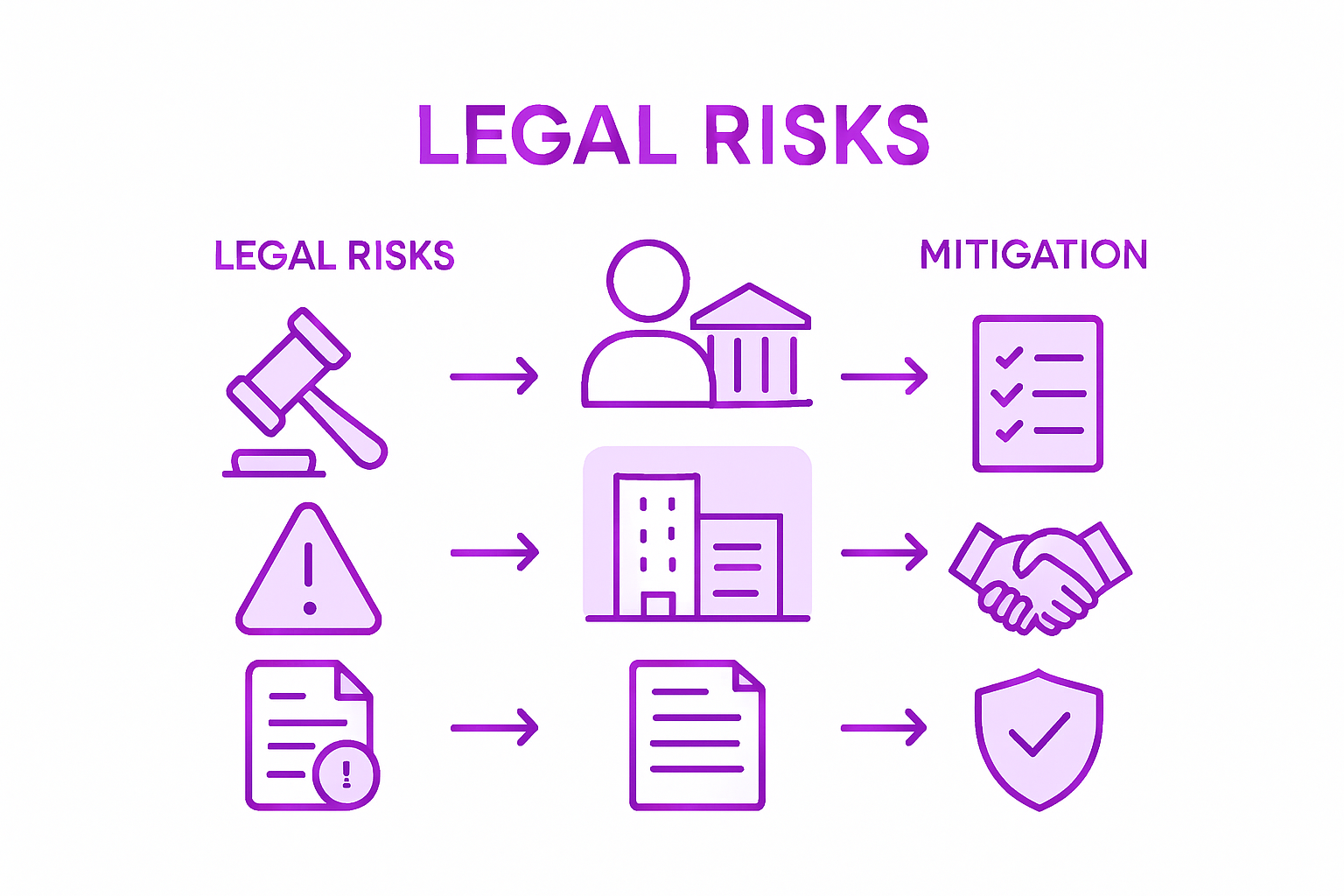
The following table summarises key legal risk categories and relevant mitigation strategies:
Legal Risk Type | Typical Scenario | Effective Mitigation Approach |
Regulatory Compliance | Breach of financial regulations | Regular legal compliance audits |
Financial Liability | Unclear payment or penalty clauses | Clear drafting and periodic reviews |
Intellectual Property | IP rights not clearly assigned | Specialist IP legal consultation |
Jurisdictional Conflict | Multiple legal systems involved | Thorough jurisdictional analysis |
Operational Constraint | Overly restrictive operational terms | Ensure clauses match business needs |
Pro Tip for Risk Management: Implement a quarterly contract review protocol that systematically reassesses existing agreements against current regulatory standards and organisational objectives.
Compliance Requirements in High-Risk Sectors
High-risk business sectors operate within intricate regulatory landscapes that demand meticulous compliance frameworks. These industries, including financial services, cryptocurrency, online gambling, and emerging technological domains, face increasingly complex legal requirements that necessitate comprehensive understanding and strategic implementation.
Research on transforming legal contracts into formal specifications highlights the critical need for precise regulatory alignment, particularly in innovative sectors like blockchain and smart contract technologies. Key compliance requirements across high-risk sectors typically encompass:
Anti-Money Laundering (AML) Protocols
Know Your Customer (KYC) Verification
Data Protection and Privacy Standards
Licensing and Regulatory Registration
Transparent Financial Reporting
Ethical Business Conduct Guidelines
Comprehensive studies emphasising pre-contractual disclosure underscore the importance of maintaining rigorous documentation and demonstrating good faith in contractual relationships. This involves implementing robust internal processes that systematically track and validate compliance across multiple regulatory dimensions.
Successful compliance management requires a proactive approach that integrates technological solutions, legal expertise, and continuous organisational learning. Businesses must develop adaptive frameworks capable of responding swiftly to evolving regulatory landscapes and emerging industry standards.
Pro Tip for Compliance Management: Establish a dedicated compliance team with cross-functional expertise and invest in ongoing training programmes to maintain current regulatory knowledge.
Cost Factors and Common Pitfalls
Contract review processes involve complex financial considerations and potential operational challenges that can significantly impact business performance. Legal contract assessment requires strategic financial planning and a nuanced understanding of both direct and indirect cost implications across various industry sectors.
Comparative research between large language models and traditional legal contract reviewers reveals critical insights into technological efficiency and potential implementation challenges. Primary cost factors and potential pitfalls businesses must consider include:
Initial Legal Review Expenses
Professional legal consultation fees
Internal resource allocation
Technology integration costs
Potential Hidden Expenses
Risk mitigation expenditures
Compliance monitoring investments
Ongoing contract management infrastructure
Common Implementation Pitfalls
Inadequate technological infrastructure
Insufficient staff training
Incomplete risk assessment mechanisms
Automatic legal contract classification research emphasises the critical balance between cost management and accuracy in contract analysis. Businesses must develop sophisticated approaches that optimise financial resources while maintaining rigorous legal standards.
Successful contract review strategies require a holistic approach that integrates technological solutions, human expertise, and adaptive financial planning. Companies must remain flexible and proactive in managing both direct expenditures and potential long-term financial implications of contractual agreements.
Pro Tip for Cost Management: Develop a comprehensive cost-benefit analysis framework that evaluates both immediate expenses and potential future financial risks associated with contract reviews.
Protect Your High-Risk Business Deals with Expert Contract Review
Navigating complex contracts in high-risk sectors demands more than just understanding legal language. The article highlights crucial challenges such as regulatory compliance risks and operational constraints that can jeopardise your business stability. At NUR Legal, we specialise in meticulous contract review tailored for industries like fintech, crypto, and gambling where precision and thoroughness matter most. Our expertise ensures your agreements are clear, compliant, and designed to protect your financial and operational interests.
Secure your business future today by partnering with trusted legal professionals at NUR Legal. Benefit from our comprehensive services including legal opinions, contract review, and licensing support across multiple jurisdictions. Don’t leave high-stakes deals to chance. Visit NUR Legal to learn how we can help you mitigate risks and confidently grow your operations in challenging markets. Get started now with tailored legal solutions that bring clarity and compliance to your contracts.
Frequently Asked Questions
What is the purpose of a contract review in high-risk business deals?
The purpose of a contract review is to systematically examine legal agreements to protect business interests, mitigate risks, and ensure compliance with relevant regulations and policies.
What are the key steps involved in the contract review process?
The key steps include initial document gathering, preliminary legal assessment, detailed clause examination, and risk and compliance evaluation to ensure comprehensive understanding and protection of contractual obligations.
Why is technology increasingly used in contract reviews?
Technology is used to enhance the accuracy and efficiency of contract reviews by automating processes, detecting errors, and facilitating risk identification, making it easier to manage large volumes of contracts.
What types of contracts require the most thorough review?
Contracts that involve significant financial investments, complex regulatory environments, or potential legal disputes, such as construction contracts, financial service agreements, and international business collaborations, require the most thorough review.
Recommended



Comments