
Why Legal Compliance Matters: Complete Expert Guide


Most british companies face mounting pressure to stay on top of a maze of regulations, and the stakes keep rising. Failing to meet compliance standards can cost organisations millions each year in fines and lost trust. Legal compliance is more than ticking a box. It is a foundation that protects business growth, integrity, and reputation in an unpredictable environment. This guide breaks down what legal compliance really means and why mastering it is essential for british businesses navigating today’s complex regulatory world.
Table of Contents
Key Takeaways
Point | Details |
Importance of Legal Compliance | Legal compliance acts as a strategic framework for organisations, helping them manage risks and maintain integrity while adhering to regulatory requirements. |
Types of Compliance in Regulated Sectors | Businesses must implement various compliance mechanisms such as regulatory, financial, data protection, operational, and reporting compliance to operate effectively within legal boundaries. |
Protective Mechanisms of Compliance | Legal compliance safeguards businesses against legal, financial, and reputational risks, transforming compliance into a proactive risk management tool. |
Consequences of Non-Compliance | Failure to comply with regulatory standards can result in significant financial penalties, legal action, and operational disruptions, highlighting the need for robust compliance strategies. |
Defining Legal Compliance And Its Importance
Legal compliance represents a critical organisational framework that encompasses understanding and adhering to the regulatory requirements governing business operations. Legal compliance involves systematically following rules, regulations, and statutory obligations established by governmental and regulatory bodies across various sectors. This comprehensive approach extends beyond mere rule-following, representing a strategic approach to risk management and organisational integrity.
The fundamental mechanisms of legal compliance are multifaceted, involving four principal compliance approaches: instrumental compliance, normative compliance, situational compliance, and habitual compliance. Each mechanism operates through distinct psychological and operational principles:
Instrumental Compliance: Driven by potential consequences and risk mitigation
Normative Compliance: Motivated by ethical standards and professional expectations
Situational Compliance: Responsive to immediate contextual requirements
Habitual Compliance: Integrated through routine and established organisational practices
For high-risk industries such as financial services, gambling, and cryptocurrency, legal compliance becomes exponentially more complex. Businesses must navigate intricate regulatory landscapes, implementing robust frameworks that protect both organisational interests and stakeholder rights. This demands continuous monitoring, proactive risk assessment, and adaptive strategies that can respond swiftly to evolving legal environments. Successful compliance transcends mere regulatory adherence, transforming into a strategic competitive advantage that builds stakeholder trust and demonstrates professional maturity.
Types Of Legal Compliance In Regulated Sectors
Legal compliance in regulated sectors encompasses a complex array of strategic approaches designed to ensure businesses operate within prescribed legal and regulatory boundaries. Digital transformation has fundamentally reshaped how organisations approach process compliance, introducing sophisticated frameworks that integrate legal requirements directly into operational methodologies. These frameworks are not merely administrative checkboxes but sophisticated systems that align business processes with intricate regulatory landscapes.
The primary types of legal compliance across regulated sectors include:
Regulatory Compliance: Adherence to specific industry regulations and governmental standards
Financial Compliance: Ensuring financial transactions, reporting, and operations meet legal requirements
Data Protection Compliance: Safeguarding sensitive information and maintaining privacy standards
Operational Compliance: Aligning business processes with legal and ethical guidelines
Reporting Compliance: Maintaining transparent and accurate documentation for regulatory review
Systematic research reveals that process compliance frameworks have evolved significantly since 1981, with increasing sophistication in verification techniques and regulatory model checking. Modern compliance strategies require comprehensive approaches that go beyond traditional rule-following, integrating proactive risk assessment, continuous monitoring, and adaptive regulatory response mechanisms. For high-risk industries such as financial services, gambling, and cryptocurrency, these compliance frameworks represent critical infrastructure that protects both organisational interests and stakeholder rights, transforming regulatory adherence from a mandatory requirement into a strategic competitive advantage.
How Legal Compliance Protects Businesses
Legal compliance serves as a critical protective mechanism that shields businesses from potential legal, financial, and reputational risks. By establishing robust frameworks that ensure organisational policies are both consistent and comprehensive with existing legal standards, businesses can proactively mitigate potential vulnerabilities. This strategic approach goes beyond mere regulatory adherence, transforming compliance into a fundamental risk management tool that safeguards organisational interests across multiple dimensions.
The primary protective mechanisms of legal compliance include:
Risk Mitigation: Identifying and neutralising potential legal vulnerabilities
Financial Protection: Preventing costly legal penalties and regulatory sanctions
Reputation Management: Maintaining stakeholder trust and organisational credibility
Operational Integrity: Ensuring ethical and lawful business practices
Transparency Enhancement: Creating clear accountability mechanisms
Corporate ethics and legal compliance are increasingly intertwined, representing a sophisticated approach to sustainable business practices. Modern organisations must navigate complex regulatory landscapes that demand more than superficial rule-following. This requires developing comprehensive compliance programs that not only meet legal mandates but also foster an ethical corporate culture. By integrating proactive compliance strategies, businesses can transform regulatory requirements from potential obstacles into strategic advantages, demonstrating their commitment to responsible governance and stakeholder protection. The most successful organisations view legal compliance not as a burdensome requirement, but as a strategic framework that enables principled growth and long-term organisational resilience.

Obligations And Risks For High-Risk Companies
High-risk companies operate within intricate regulatory landscapes that demand comprehensive compliance strategies and sophisticated risk management approaches. Emerging technologies like RegTech are transforming how organisations address complex regulatory challenges, providing innovative solutions to mitigate potential legal and operational vulnerabilities. These technological advancements enable businesses to navigate increasingly complex compliance requirements with greater precision and efficiency.
The primary obligations for high-risk companies include:
Comprehensive Risk Assessment: Identifying and evaluating potential legal and operational risks
Regulatory Reporting: Maintaining transparent and accurate documentation
Ethical Technology Implementation: Ensuring technological solutions meet legal standards
Continuous Compliance Monitoring: Proactively tracking regulatory changes
Robust Internal Controls: Developing stringent governance mechanisms
The integration of artificial intelligence in business processes introduces significant compliance challenges, particularly in sectors like finance and healthcare. Modern high-risk companies must develop frameworks that ensure technological solutions are ethical, controllable, and aligned with regulatory requirements. This demands a sophisticated approach that balances operational performance with legal compliance, creating systems that are not only technologically advanced but also transparently governed. The most successful organisations will be those that can seamlessly integrate cutting-edge technologies while maintaining rigorous adherence to evolving regulatory standards, transforming compliance from a potential obstacle into a strategic competitive advantage.
Costly Consequences Of Non-Compliance
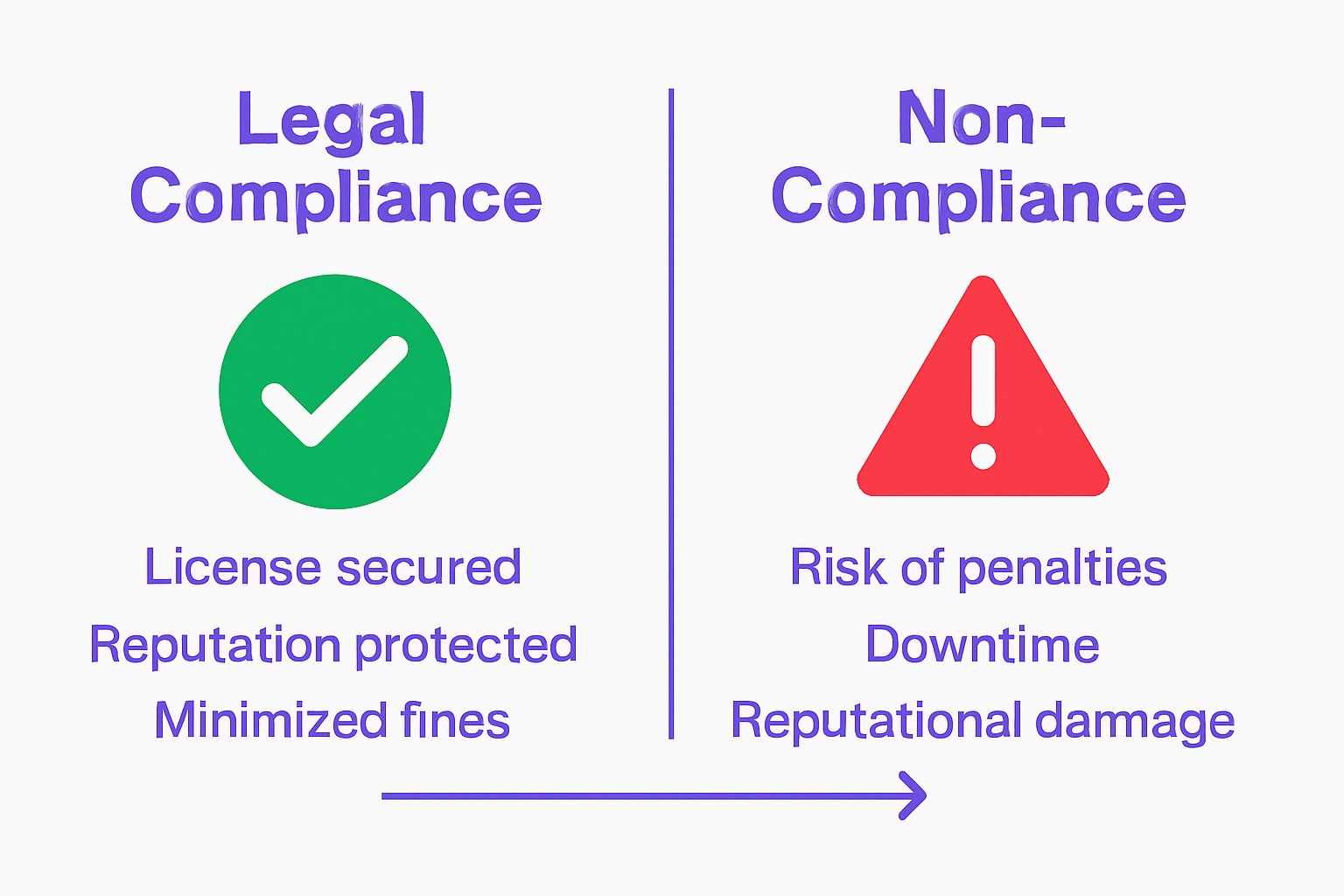
Legal compliance represents a critical framework that extends beyond simple rule-following, with non-compliance presenting potentially catastrophic financial and reputational risks for businesses. Organisations that fail to meet regulatory standards can face a cascading series of consequences that threaten their operational stability, financial health, and long-term market viability. The repercussions of non-compliance are not merely punitive but can fundamentally undermine an organisation’s strategic capabilities and stakeholder trust.
The primary financial and operational consequences of non-compliance include:
Substantial Financial Penalties: Significant monetary fines from regulatory bodies
Legal Prosecution: Potential criminal and civil legal proceedings
Operational Disruption: Forced business suspensions or licence revocations
Reputational Damage: Erosion of stakeholder and customer confidence
Market Restrictions: Limitations on business activities and market access
Corporate ethics and compliance are increasingly interconnected, with non-compliance representing more than a technical violation. Modern businesses must recognise that regulatory adherence is fundamentally about maintaining transparency, ethical standards, and sustainable operational practices. The most sophisticated organisations view compliance not as a bureaucratic obstacle, but as a strategic framework that protects organisational integrity. Businesses that proactively develop comprehensive compliance strategies can transform potential regulatory challenges into opportunities for demonstrating corporate responsibility, ultimately building stronger relationships with regulators, investors, and customers.
Secure Your Business Future with Expert Legal Compliance Support
Navigating the intricate world of legal compliance in high-risk sectors such as fintech, crypto, and gambling requires more than basic knowledge. This guide highlights the profound importance of systematic legal adherence to mitigate risks, prevent costly penalties, and build lasting trust with regulators and stakeholders. If your goal is to establish a robust, legally compliant operation that transforms regulatory challenges into strategic advantages, expertise and tailored support are essential.
At NUR Legal, we specialise in helping businesses like yours obtain critical licenses including crypto licences in Georgia and Seychelles or full gaming licences from Curaçao and Anjouan quickly and affordably. Our comprehensive legal consultancy also includes contract review, legal opinions, and global company formation designed to ensure your compliance frameworks meet evolving regulations with confidence. Don’t wait for regulations to catch you off guard. Take action today and partner with the industry’s trusted legal advisors who understand the stakes and are committed to your long-term success. Explore our services now at NUR Legal and discover how expert guidance can protect and propel your business forward.
Frequently Asked Questions
What is legal compliance?
Legal compliance refers to the framework of understanding and adhering to regulatory requirements governing business operations, ensuring that organisations follow the rules and regulations set by governmental and regulatory bodies.
Why is legal compliance important for businesses?
Legal compliance is crucial as it helps businesses mitigate risks, avoid legal penalties, protect their reputation, and ultimately contribute to sustainable growth by demonstrating ethical practices and maintaining stakeholder trust.
What are the main types of legal compliance?
The primary types of legal compliance include regulatory compliance, financial compliance, data protection compliance, operational compliance, and reporting compliance, each addressing specific industry requirements and standards.
What are the consequences of non-compliance?
Non-compliance can lead to substantial financial penalties, legal prosecution, operational disruptions, reputational damage, and limitations on market access, posing significant risks to an organisation’s stability and viability.
Recommended


Comments