
The Essential Guide to Legal Consultancy Services

Updated: Nov 30, 2025

Many british companies underestimate how complex legal consultancy has become, with research showing that over 80 percent of businesses face confusion about what these services truly offer. Understanding the real scope of legal consultancy matters because it shapes how organisations address risk, achieve compliance, and drive business growth. This guide sheds light on what sets quality legal consultancy apart, explains common myths, and helps you see the real impact it can have on your operations.
Table of Contents
Key Takeaways
Point | Details |
Legal consultancy is a strategic service | It provides tailored solutions and in-depth analysis for businesses navigating complex regulatory environments. |
Technology enhances consultancy effectiveness | Advanced tools like AI are utilised to improve precision and streamline compliance processes, moving beyond traditional methods. |
Partner selection is crucial | Evaluating the multidisciplinary expertise and technological capability of legal consultants is essential for successful partnerships. |
Navigating regulatory landscapes requires proactive strategies | Legal consultants aid in anticipating regulatory challenges through comprehensive risk assessment and customised compliance protocols. |
Legal Consultancy Defined And Common Misconceptions
Legal consultancy represents a sophisticated professional service where specialised legal experts provide strategic advice, analytical insights, and expert guidance to businesses navigating complex regulatory environments.
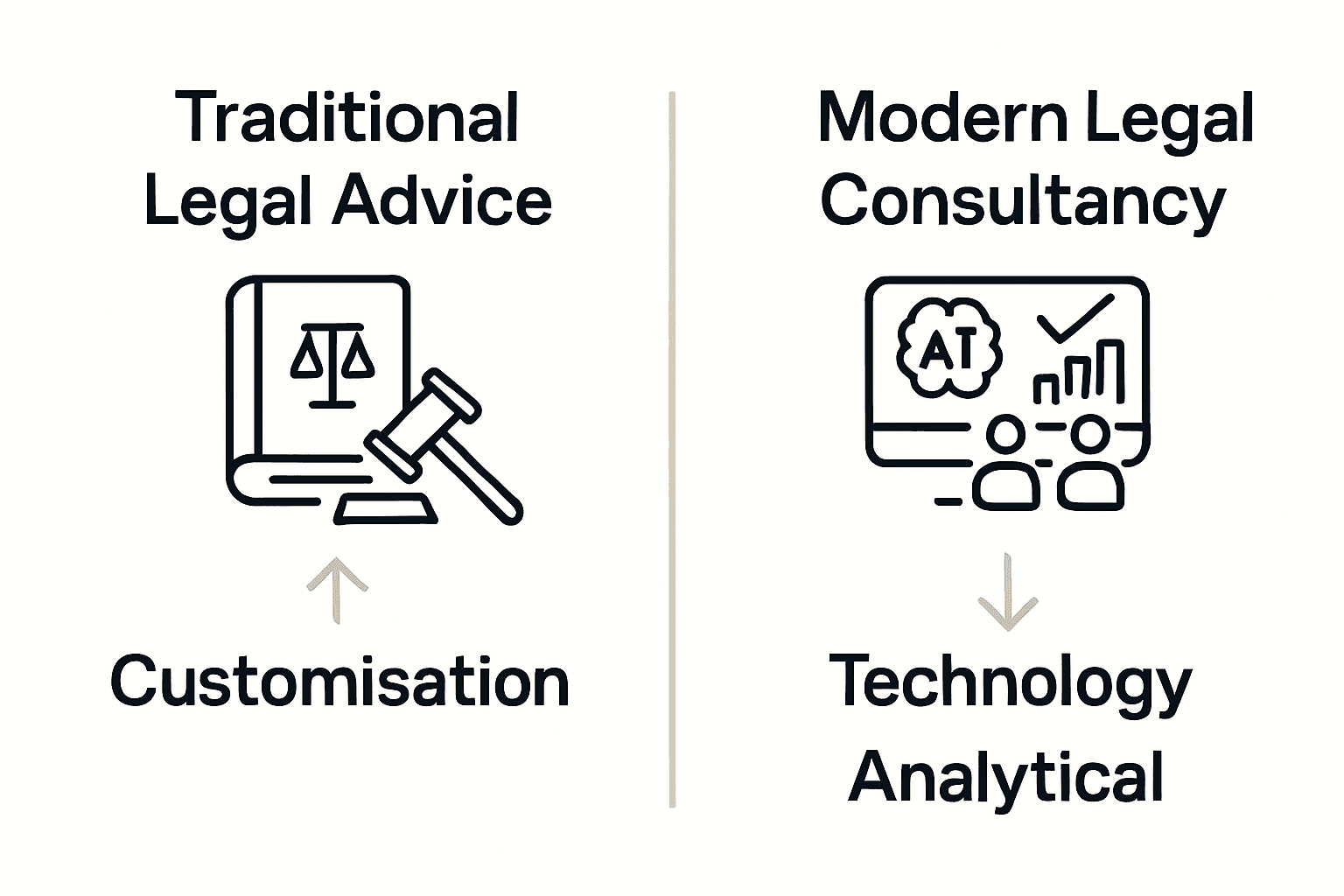
As revealed by research from appj, these services are fundamentally intellectual products that clients retain for comprehensive problem-solving and strategic decision-making across various industry sectors.
Contrary to popular belief, legal consultancy is not merely about offering generic recommendations, but involves deep contextual understanding, nuanced risk assessment, and tailored solutions specific to each client’s unique operational landscape. The misconception that legal consultants provide standardised advice overlooks the intricate analytical processes involved. As demonstrated by research from jols, modern legal consultancy increasingly integrates advanced technologies like artificial intelligence to enhance precision and depth of insights, while maintaining critical human expertise and judgement.
Key characteristics that distinguish high-quality legal consultancy services include:
Comprehensive Analytical Approach: Moving beyond surface-level legal interpretations
Strategic Problem-Solving: Developing proactive solutions rather than reactive responses
Regulatory Expertise: Deep understanding of complex legal frameworks across different industries
Technological Integration: Utilising advanced tools and AI to enhance analytical capabilities
Customised Guidance: Tailoring recommendations to specific business contexts and challenges
Professional legal consultancy fundamentally bridges the gap between complex legal requirements and practical business implementation, offering clients a strategic pathway through intricate regulatory landscapes. By combining specialised knowledge, technological insights, and industry-specific expertise, legal consultants provide an invaluable service that goes far beyond traditional legal advice.
Types Of Legal Consultancy Services Available
Legal consultancy services encompass a broad spectrum of specialised professional offerings designed to address complex legal challenges across diverse business domains. As highlighted by research from njagaadvocates, these services range from comprehensive legal research and analysis to strategic policy advisory and sophisticated risk management solutions tailored to specific organisational needs.
The contemporary legal consultancy landscape has dramatically evolved, integrating technological innovations to enhance service delivery. According to research from academic, next-generation law companies are increasingly leveraging artificial intelligence and advanced technological platforms to provide more precise, efficient, and adaptive legal consulting services. This technological transformation enables legal consultants to offer more nuanced, data-driven insights across multiple practice areas.
Key types of legal consultancy services include:
Regulatory Compliance Consulting: Ensuring businesses meet complex legal and industry-specific requirements
Corporate Governance Advisory: Providing strategic guidance on organisational legal structures and governance frameworks
Risk Management Services: Identifying, assessing, and mitigating potential legal and operational risks
Licensing and Authorisation Support: Assisting businesses in obtaining necessary legal permissions and operational licences
International Legal Strategy: Developing cross-jurisdictional legal approaches for global business operations
Technological Integration Consulting: Advising on legal implications of emerging technologies and digital transformation
These diverse legal consultancy services represent a sophisticated ecosystem of professional support, enabling businesses to navigate increasingly complex regulatory environments with precision, strategic insight, and technological sophistication. By offering specialised expertise across multiple domains, legal consultants provide critical infrastructure for organisational legal resilience and strategic decision-making.

How Legal Consultants Streamline Compliance Processes
Legal consultants play a critical role in transforming complex regulatory compliance from a challenging administrative burden into a strategic organisational advantage. As revealed by research from arxiv, advanced technologies like the Legal Intelligence and Client Engagement System (LICES) are revolutionising how legal professionals approach compliance management through sophisticated AI-driven architectures that integrate natural language processing and comprehensive legal databases.
The compliance streamlining process involves multiple sophisticated strategies that go beyond traditional checklist-based approaches. According to research from arxiv, modern legal consultants are implementing adaptive refinement frameworks that enhance decision-making accuracy and contextual relevance. These approaches enable businesses to develop more nuanced, proactive compliance strategies that anticipate regulatory challenges rather than merely reacting to them.
Key mechanisms legal consultants employ to streamline compliance processes include:
Technological Integration: Deploying advanced AI and machine learning tools to automate complex compliance monitoring
Risk Assessment Frameworks: Developing comprehensive predictive models to identify potential regulatory vulnerabilities
Continuous Monitoring Systems: Creating dynamic tracking mechanisms for evolving regulatory landscapes
Customised Compliance Protocols: Designing industry-specific strategies tailored to unique organisational requirements
Regulatory Intelligence: Aggregating and analysing complex legal information from multiple jurisdictional sources
Strategic Advisory Services: Providing proactive guidance on emerging regulatory trends and potential compliance challenges
By leveraging sophisticated technological tools and deep regulatory expertise, legal consultants transform compliance from a static administrative function into a dynamic, strategic organisational capability. Their approach moves beyond mere regulatory adherence, positioning compliance as a critical component of strategic business intelligence and risk management.
Legal Frameworks For High-Risk And Regulated Industries
Navigating legal frameworks for high-risk and regulated industries requires sophisticated, adaptive approaches that blend technological innovation with comprehensive regulatory understanding. As demonstrated by research from arxiv, modern legal strategies increasingly leverage advanced multi-agent collaborative systems like Chatlaw, which integrate knowledge graphs and expert systems to provide nuanced navigation of complex regulatory landscapes across diverse high-risk sectors.
The intricate nature of legal frameworks in regulated industries demands a multifaceted approach that goes beyond traditional compliance methodologies. According to research from arxiv, emerging technologies such as large language models are transforming legal analysis by enabling more sophisticated interpretation of complex regulatory requirements. These technological innovations allow legal professionals to develop more precise, context-aware strategies for managing regulatory challenges in sectors characterised by high complexity and significant legal risk.
Key components of effective legal frameworks for high-risk industries include:
Comprehensive Risk Assessment: Developing holistic models that anticipate potential regulatory vulnerabilities
Dynamic Compliance Mechanisms: Creating adaptive systems that can quickly respond to evolving regulatory environments
Technological Integration: Leveraging AI and advanced analytical tools to enhance legal interpretations
Cross-Jurisdictional Analysis: Understanding and navigating legal requirements across multiple regulatory domains
Proactive Regulatory Monitoring: Implementing continuous tracking systems for emerging legal developments
Specialised Industry Expertise: Developing deep understanding of sector-specific regulatory nuances
These sophisticated legal frameworks represent a transformative approach to regulatory compliance, moving beyond traditional reactive strategies to create proactive, intelligent systems that anticipate and mitigate potential legal challenges. By integrating advanced technological tools with deep regulatory expertise, legal professionals can develop more resilient, adaptable approaches to managing complex regulatory environments.
Key Risks And Benefits Of Legal Consultancy
Legal consultancy represents a complex landscape of strategic opportunities and potential challenges that businesses must carefully navigate. As revealed by research from academic, the emergence of AI-enabled business models has fundamentally transformed legal services, introducing both remarkable benefits and significant risks that demand sophisticated understanding and strategic management.
The technological evolution of legal consultancy brings profound implications for organisational risk management. According to research from arxiv, modern legal consulting increasingly relies on artificial intelligence frameworks that offer unprecedented process efficiency, while simultaneously presenting challenges such as potential information inaccuracies and the critical need for robust verification mechanisms. These technological advancements create a nuanced environment where innovative solutions coexist with potential computational limitations.
Key risks and benefits of contemporary legal consultancy include:
Enhanced Efficiency: Dramatically reduced processing times for complex legal analyses
Cost Reduction: Minimising expensive manual legal research and documentation processes
Data Privacy Vulnerabilities: Potential exposure of sensitive organisational information
Technological Limitations: Risk of AI-generated ‘hallucinations’ or incorrect legal interpretations
Comprehensive Risk Assessment: Advanced predictive capabilities for identifying potential legal challenges
Scalable Legal Support: Ability to provide sophisticated legal insights across diverse business contexts
Ultimately, legal consultancy represents a sophisticated ecosystem where technological innovation and human expertise converge. Successful implementation requires a balanced approach that leverages technological capabilities while maintaining rigorous human oversight and critical analytical judgement. By understanding and strategically managing both the risks and benefits, organisations can transform legal consultancy from a traditional support function into a dynamic, strategic business advantage.
Costs, Common Pitfalls And Selecting The Right Partner
Selecting an appropriate legal consultancy partner represents a critical strategic decision that can profoundly impact an organisation’s regulatory compliance and operational effectiveness. As highlighted by research from njagaadvocates, the selection process requires careful evaluation of multidisciplinary expertise and a demonstrable client-centric approach that extends beyond traditional legal advisory services.
The financial and operational implications of legal consultancy partnerships demand comprehensive assessment and strategic planning. Research from ajoeijournal reveals that organisations frequently encounter significant challenges when adopting technological capabilities and selecting legal consulting partners, emphasising the need for a nuanced, methodical approach to partner selection that considers both immediate costs and long-term strategic alignment.
Key considerations when evaluating legal consultancy partnerships include:
Expertise Verification: Thoroughly assessing the consultant’s track record in specific industry domains
Cost Structure Transparency: Understanding comprehensive pricing models and potential hidden expenses
Technological Capability: Evaluating the firm’s technological infrastructure and innovation potential
Compliance Depth: Examining the consultant’s understanding of complex regulatory frameworks
Scalability Potential: Assessing the partner’s ability to adapt to evolving organisational needs
Communication Protocols: Establishing clear expectations for reporting and collaborative engagement
Ultimately, selecting the right legal consultancy partner requires a holistic approach that balances technical expertise, financial considerations, and strategic alignment. Successful partnerships transcend traditional transactional relationships, creating collaborative ecosystems that provide strategic insights, mitigate risks, and drive organisational resilience in increasingly complex regulatory environments.
Navigate Complex Legal Challenges with Expert Support from Nur Legal
The article emphasises how legal consultancy goes beyond basic advice, offering tailored strategies that integrate deep regulatory knowledge and technological innovation to streamline compliance and manage risk. If you are facing the daunting landscape of corporate licensing, regulatory compliance, or high-risk industry challenges such as fintech or crypto, Nur Legal specialises in transforming these complexities into clear, manageable processes. With expertise in securing licences like Curaçao gaming or crypto licences in Georgia and Seychelles, Nur Legal helps you build a legally compliant and resilient operation worldwide.
Ready to move from legal uncertainty to confident compliance? Explore how Nur Legal provides transparent, efficient, and affordable legal consultancy designed for startups and established businesses operating in technically demanding sectors. Visit our services at Nur Legal to learn how we support your growth with strategic legal insights and licensing solutions tailored for your industry. Take the first step towards streamlined legal compliance and global expansion today.
Frequently Asked Questions
What is legal consultancy?
Legal consultancy is a professional service where specialised legal experts provide strategic advice, analytical insights, and guidance to businesses navigating complex regulatory environments.
What types of services do legal consultants offer?
Legal consultants offer a range of services including regulatory compliance consulting, corporate governance advisory, risk management services, licensing support, and international legal strategy development.
How do legal consultants help streamline compliance processes?
Legal consultants streamline compliance processes by integrating advanced technologies, developing risk assessment frameworks, and creating customised compliance protocols that adapt to evolving regulatory requirements.
What are the key benefits of hiring a legal consultancy?
Key benefits include enhanced efficiency in legal processes, cost reduction, advanced predictive risk assessment, and access to specialised expertise that helps businesses navigate complex regulatory challenges.


Comments