
Why Obtain Offshore Licence: Fast Access for Fintech


Launching a high-risk fintech startup in Europe means facing complex compliance demands and steep licensing costs at every turn. For founders seeking rapid market entry and operational freedom, offshore licences offer a strategic solution that combines regulatory flexibility with competitive tax conditions. By exploring international licensing options, founders can unlock faster crypto and gambling authorisation while maintaining strict legal standards and robust financial privacy. This article highlights what offshore licences truly mean and why they stand out as the smart path for ambitious innovators.
Table of Contents
Key Takeaways
Point | Details |
Offshore Licences Provide Strategic Advantages | Offshore licencing enables fintech firms to optimise tax strategies, ensure regulatory flexibility, and enhance global market penetration. |
Different Types of Offshore Licences | Type A licences allow comprehensive banking services, while Type B licences are tailored for specific client segments, crucial for high-risk sectors. |
Rigorous Compliance is Essential | Establishing offshore operations requires meticulous documentation and adherence to stringent regulatory frameworks to maintain licencing status. |
Cost and Risk Management Are Critical | Businesses must budget adequately for application and maintenance fees and develop strong risk management protocols to mitigate potential challenges. |
Offshore licence meaning and core benefits
An offshore licence represents a strategic legal authorisation permitting businesses to operate financial services beyond their primary jurisdiction. Offshore banking operations provide companies with innovative mechanisms to establish international financial presence while maintaining robust regulatory compliance and strategic advantages.
The core benefits of obtaining an offshore licence encompass multiple strategic dimensions for fintech enterprises:
Tax Optimisation: Significant reduction in corporate taxation rates
Regulatory Flexibility: Access to more accommodating regulatory environments
Global Market Penetration: Faster international business expansion
Asset Protection: Enhanced financial privacy and security mechanisms
Operational Cost Reduction: Lower compliance and operational expenditures
Financial technology companies seeking rapid market entry find offshore licences particularly attractive because they enable swift establishment of cross-border financial service infrastructures. By selecting jurisdictions with progressive regulatory frameworks, organisations can bypass complex domestic licensing procedures while maintaining professional operational standards.
Pro tip: Research multiple offshore jurisdictions carefully, comparing their specific regulatory requirements, taxation policies, and compliance standards before selecting your optimal licensing destination.
Types of offshore licences for high-risk sectors
Navigating the complex landscape of offshore licencing requires understanding the nuanced banking licence types available for high-risk financial sectors. These specialised authorisations provide strategic frameworks for businesses operating in technically challenging regulatory environments.
Primarily, offshore licences can be categorised into two fundamental classifications:
Type A (General) Licences:
Permit comprehensive banking services
Enable full international non-resident financial operations
Ideal for comprehensive commercial banking strategies
Type B (Limited) Licences:
Restrict activities to specific client segments
Focus on targeted corporate cash flow management
Suitable for niche financial service providers
High-risk sectors such as cryptocurrency exchanges, online gambling platforms, and alternative financial services particularly benefit from these offshore licensing models. By selecting an appropriate licence type, organisations can strategically position themselves in global markets while maintaining robust compliance and operational flexibility. Licensing requirements for high-risk industries demand meticulous attention to regulatory nuances and jurisdictional specificities.

Pro tip: Conduct comprehensive due diligence on potential offshore jurisdictions, examining their regulatory reputation, compliance standards, and long-term stability before committing to a specific licence type.
How offshore licensing frameworks operate
Offshore licensing frameworks represent complex regulatory mechanisms designed to enable businesses to establish international financial operations with strategic precision. Offshore banking license processes involve multiple intricate stages of regulatory scrutiny and comprehensive documentation requirements.
The typical offshore licensing framework encompasses several critical stages:
Initial Application Stage:
Detailed business objective documentation
Comprehensive shareholder and director background checks
Submission of robust business plans
Verification of capital reserve requirements
Compliance and Validation Phase:
Anti-money laundering (AML) regulation verification
Rigorous personnel vetting procedures
Assessment of operational risk management strategies
Periodic reporting obligations
These frameworks are meticulously designed to provide financial institutions with operational flexibility while maintaining strict regulatory oversight. By implementing sophisticated legal compliance workflows, offshore jurisdictions create environments that balance business innovation with robust regulatory controls. The strategic approach ensures that financial entities can access international markets while adhering to comprehensive legal standards.
Pro tip: Prepare exhaustive documentation and engage specialised legal consultants to navigate the complex offshore licensing landscape effectively and minimise potential regulatory challenges.
Popular jurisdictions and eligibility criteria
Selecting an optimal offshore licensing jurisdiction requires strategic evaluation of multiple critical factors that impact fintech and high-risk financial operations. Crypto licensing trends demonstrate the increasing complexity of international financial regulatory landscapes.
Key jurisdictions renowned for their offshore licensing frameworks include:
European Offshore Locations:
Gibraltar
Malta
Cyprus
Estonia
Caribbean and Pacific Regions:
Curaçao
British Virgin Islands
Seychelles
Anjouan
Eligibility criteria typically encompass several rigorous requirements designed to ensure operational integrity and regulatory compliance. Financial technology enterprises must demonstrate:
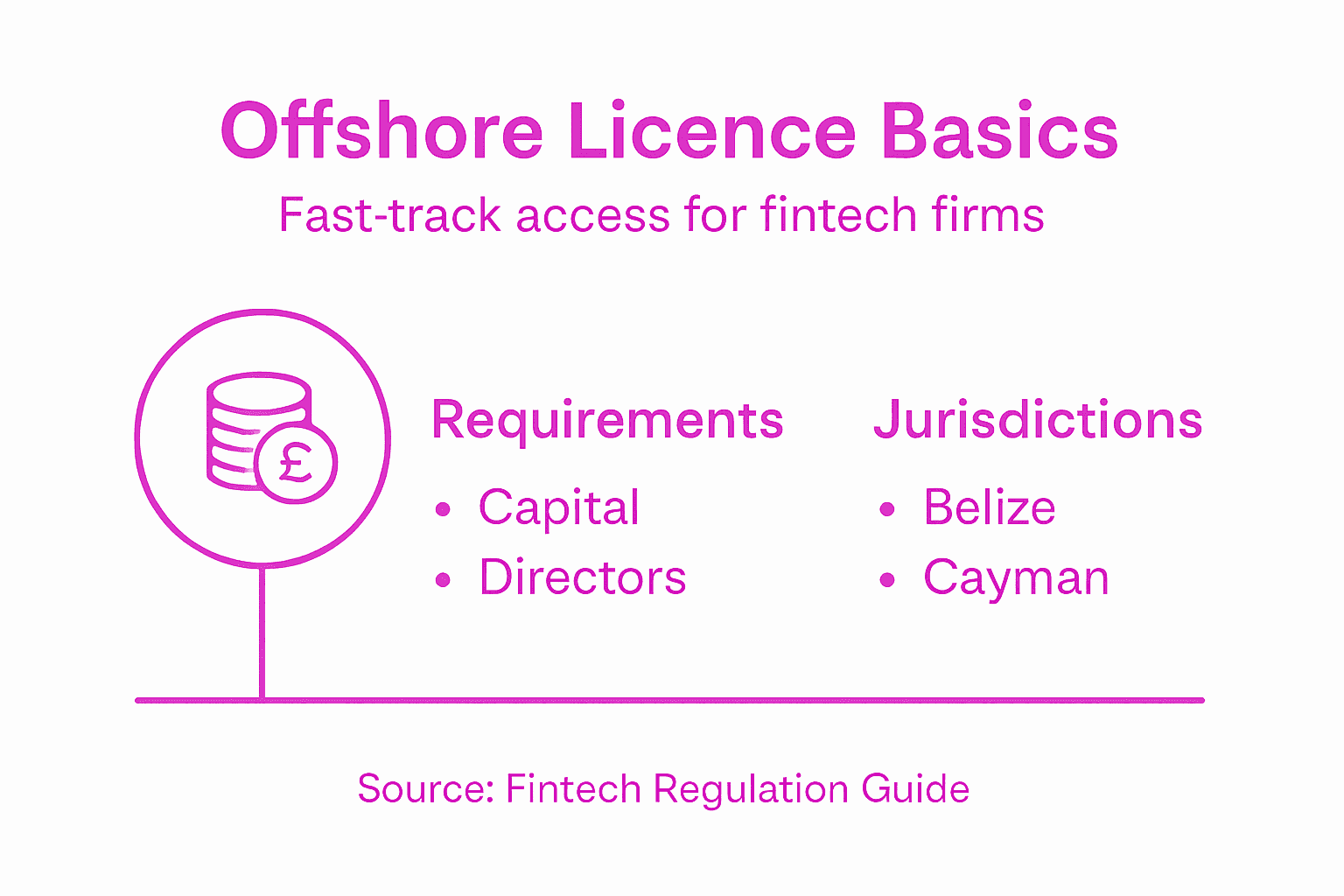
This table summarises eligibility factors for offshore financial licencing across major jurisdictions:
Jurisdiction | Minimum Capital | AML Standard Strength | Governance Review Rigour |
Malta | £5 million | Very high | Detailed, regulator checks |
British Virgin Islands | £1 million | Moderate | Formal, less frequent |
Seychelles | £0.5 million | High | Thorough, periodic |
Gibraltar | £2 million | High | Strict, ongoing reviews |
Robust corporate governance structures
Comprehensive business operational plans
Sufficient initial capital reserves
Proven anti-money laundering (AML) protocols
Experienced management team with relevant industry expertise
Pro tip: Conduct comprehensive due diligence on potential licensing jurisdictions, focusing on their regulatory reputation, compliance standards, and potential future regulatory developments before making a final selection.
Risks, costs, and management obligations
Offshore licensing for high-risk financial sectors involves sophisticated financial calculations and comprehensive risk management strategies. Regulatory due diligence becomes paramount when navigating complex international financial frameworks.
Financial implications and management obligations typically include:
Cost Structure:
Initial application fees (£10,000 - £50,000)
Annual licence maintenance expenses
Minimum capital reserve requirements
Ongoing compliance management costs
Primary Risk Categories:
International regulatory environment changes
Reputational vulnerability
Financial stability challenges
Potential licence revocation
Management obligations demand rigorous operational protocols, including comprehensive reporting mechanisms, transparent financial practices, and continuous regulatory alignment. Companies must develop sophisticated anti-money laundering protocols, implement robust governance structures, and maintain meticulous documentation to sustain their offshore licensing status.
Pro tip: Allocate a dedicated compliance budget representing 15-20% of your operational expenses to effectively manage ongoing regulatory requirements and mitigate potential licensing risks.
Onshore versus offshore licensing comparison
Understanding the critical distinctions between onshore and offshore licensing requires nuanced financial strategy. Offshore banking licenses represent sophisticated legal mechanisms that enable businesses to operate with enhanced strategic flexibility.
Key comparative dimensions include:
Onshore Licensing Characteristics:
Strict local regulatory compliance
Higher operational transparency requirements
Comprehensive domestic market service obligations
Substantial administrative overhead
Full domestic tax liability
Offshore Licensing Characteristics:
Reduced regulatory burdens
Enhanced confidentiality protections
Minimal local market service requirements
Restricted to non-resident or international operations
Potential tax optimization opportunities
Financial technology enterprises must carefully evaluate these frameworks against their specific operational objectives. While offshore structures offer greater administrative flexibility, they simultaneously demand rigorous compliance mechanisms to maintain legal legitimacy. Strategic selection between onshore and offshore models depends on precise business goals, target markets, and risk management capabilities.
The following table provides a side-by-side overview of offshore and onshore licencing impacts for financial technology firms:
Dimension | Offshore Licencing Impact | Onshore Licencing Impact |
Operational Flexibility | High, supports global expansion | Limited, focused on domestic market |
Regulatory Requirements | Variable, can be less stringent | Stringent, regular local audits |
Confidentiality | Greater privacy and protection | Public transparency often mandated |
Tax Exposure | Potential for reduced obligations | Full domestic tax liability |
Administrative Overhead | Lower due to streamlined protocols | Higher, complex documentation needed |
Pro tip: Engage specialised legal consultants to conduct a comprehensive comparative analysis of onshore and offshore licensing options specific to your business model and international expansion strategy.
Unlock Fast and Compliant Offshore Licensing for Your Fintech Venture
Navigating the complexities of offshore licences to access international markets swiftly can be daunting. From rigorous compliance requirements to selecting the right jurisdiction with robust AML protocols, fintech businesses face critical challenges when seeking rapid and reliable licensing solutions. Whether you aim to benefit from tax optimisation, regulatory flexibility, or enhanced asset protection, specialised legal guidance is essential in avoiding costly delays and compliance pitfalls.
At NUR Legal, we understand these challenges perfectly. Our expert team specialises in securing high-risk financial licences including crypto and gaming licences in trusted jurisdictions like Curaçao, Anjouan, Georgia, and Seychelles. We provide tailored support to establish legally compliant operations that align with your strategic goals while navigating complex regulatory frameworks efficiently. Discover how our comprehensive services including company formation, contract review, and ongoing compliance assistance can accelerate your entry into global fintech markets.
Ready to fast-track your offshore licence application and access new markets with confidence? Visit NUR Legal to explore our trusted services. Learn more about our crypto licensing solutions and gaming licensing expertise designed to meet the exacting demands of high-risk industries. Take the next step towards unlocking global growth today.
Frequently Asked Questions
What are the core benefits of obtaining an offshore licence for fintech companies?
The core benefits include tax optimisation, regulatory flexibility, global market penetration, asset protection, and operational cost reduction, allowing for rapid growth and expansion in international markets.
What types of offshore licences are available for high-risk sectors?
There are primarily two types: Type A (General) Licences that permit comprehensive banking services and Type B (Limited) Licences that restrict activities to specific client segments, suitable for targeted services like corporate cash flow management.
How does the offshore licensing process operate?
The process typically involves an initial application stage that requires detailed documentation and compliance checks followed by a validation phase that includes anti-money laundering regulations and risk management assessments.
What are the differences between offshore and onshore licensing?
Offshore licensing offers reduced regulatory burdens, enhanced confidentiality, and potential tax optimisation, while onshore licensing is characterised by strict compliance, higher transparency, and full domestic tax liabilities.
Recommended


Comments